

EV Charging for Commercial Property: A Practical Guide
A property manager usually starts with a simple request: add a few EV chargers near the front entrance before tenants or customers ask again. Then the electrical room changes the conversation. The available panel space is limited, the service is already carrying HVAC and refrigeration loads, and the utility wants to review anything that could raise the site's peak demand.
That's why EV charging for commercial property is an electrical-capacity and operating-model decision before it's an equipment purchase. Public charging infrastructure is expanding quickly. The International Energy Agency reports that more than 1.3 million public charging points were added worldwide during 2024, increasing the global stock by more than 30% in one year. Commercial sites, including workplaces, retail centers, hotels, parking facilities, and fleet locations, are part of that infrastructure.
The practical question isn't “How many chargers fit in the parking lot?” It's “What charging service can this building deliver safely, reliably, and affordably with its existing electrical envelope?”
Table of Contents
Why the Electrical Panel Determines the Project Scope - Start with capacity, not hardware - Treat the building and parking lot as one system
Sizing Demand Before You Size Chargers - Build the demand picture - Turn survey answers into a load model
Panel Upgrades, Service Upgrades, and Managed Load - Reuse, extend, or rebuild - Use managed load deliberately
Site Layout, Accessibility, and Physical Usability - Screen the physical installation - Commission the user experience
Metering, Payment, and Who Actually Pays - Compare the ownership structures
Permitting, Installation, and Commissioning in the Right Order - Confirm the utility path first - Build, inspect, and activate
Why the Electrical Panel Determines the Project Scope
A small office in Southeastern Pennsylvania may have a 200-amp service, a crowded panel, and only a few employees who currently drive electric vehicles. Open parking spaces do not establish feasibility. The service calculation, panel capacity, conductor routing, and utility requirements determine whether the installation stays simple or becomes a service-upgrade project.
A retail strip center has a different constraint. Rooftop units, lighting, refrigeration, signage, and tenant loads may already push the main panel near its practical limit. Adding chargers without measuring the existing load can cause nuisance trips, trigger a redesign, or expose the owner to utility demand charges that were missing from the original business case.
Practical rule: Start the first site visit in the electrical room, then walk the route to the parking spaces.
Start with capacity, not hardware
Document the existing service rating, panel schedules, feeder sizes, open breaker positions, transformer capacity, and interval load profile. A visual inspection can show that a panel is crowded, but it cannot confirm how much usable capacity remains under the building's calculated and measured load.
A spare breaker position is not proof that the service can support another large continuous load. The design must also address overcurrent protection, conductor sizing, voltage drop, equipment clearances, grounding, and the electrical code adopted by the local authority having jurisdiction.
Owners considering a panel replacement or service increase should make those decisions separately from charger selection. A commercial electrical panel upgrade assessment can help determine whether the project requires panel work, a new feeder, a sub-panel, a service upgrade, or tighter control of charging demand.
Treat the building and parking lot as one system
The charger may sit at the far end of the lot, but the building still supplies it. The route from the service equipment to each parking space can therefore become the main design constraint. Long conduit runs, pavement cuts, directional boring, transformer access, and equipment protection may affect cost and constructability more than the charger enclosure.
Charging power is also becoming more varied. The IEA defines fast chargers as equipment above 22 kilowatts and below 150 kilowatts, and reports that the global stock of fast chargers reached approximately 2 million in 2024. Ultra-fast chargers rated at 150 kilowatts or more grew by over 50% during that year and represented nearly 10% of all fast chargers, according to its charging analysis.
For many offices and small retail properties, managed Level 2 charging is a better starting point than high-power equipment. The choice should follow dwell time, fleet requirements, utility tariffs, and the service capacity confirmed during the assessment. That sequence prevents the charger specification from dictating a project the building cannot support.
Sizing Demand Before You Size Chargers
A property can have plenty of parking and still lack the electrical capacity for every charger to run at full output. Start with three separate questions: how many ports users need, how much simultaneous charging power the site can support, and how much total daily energy vehicles are likely to consume. These measures often produce different answers.
An office may need several ports because employees arrive and leave at different times, while a retail property may need faster turnover during shorter visits. A fleet depot faces another constraint: vehicles return on a predictable schedule, then must be ready within a limited window. The operating pattern should determine the load model before anyone selects charger hardware.
The Department of Energy workplace charging guidance recommends surveying employees about charging frequency, then using the responses to estimate ports, energy demand, and user fees. Ask tenants, employees, visitors, and fleet managers which vehicles may charge, on which days, and for how long. A property-specific survey gives a more useful starting point than a generic charger-to-parking-space ratio.
Build the demand picture
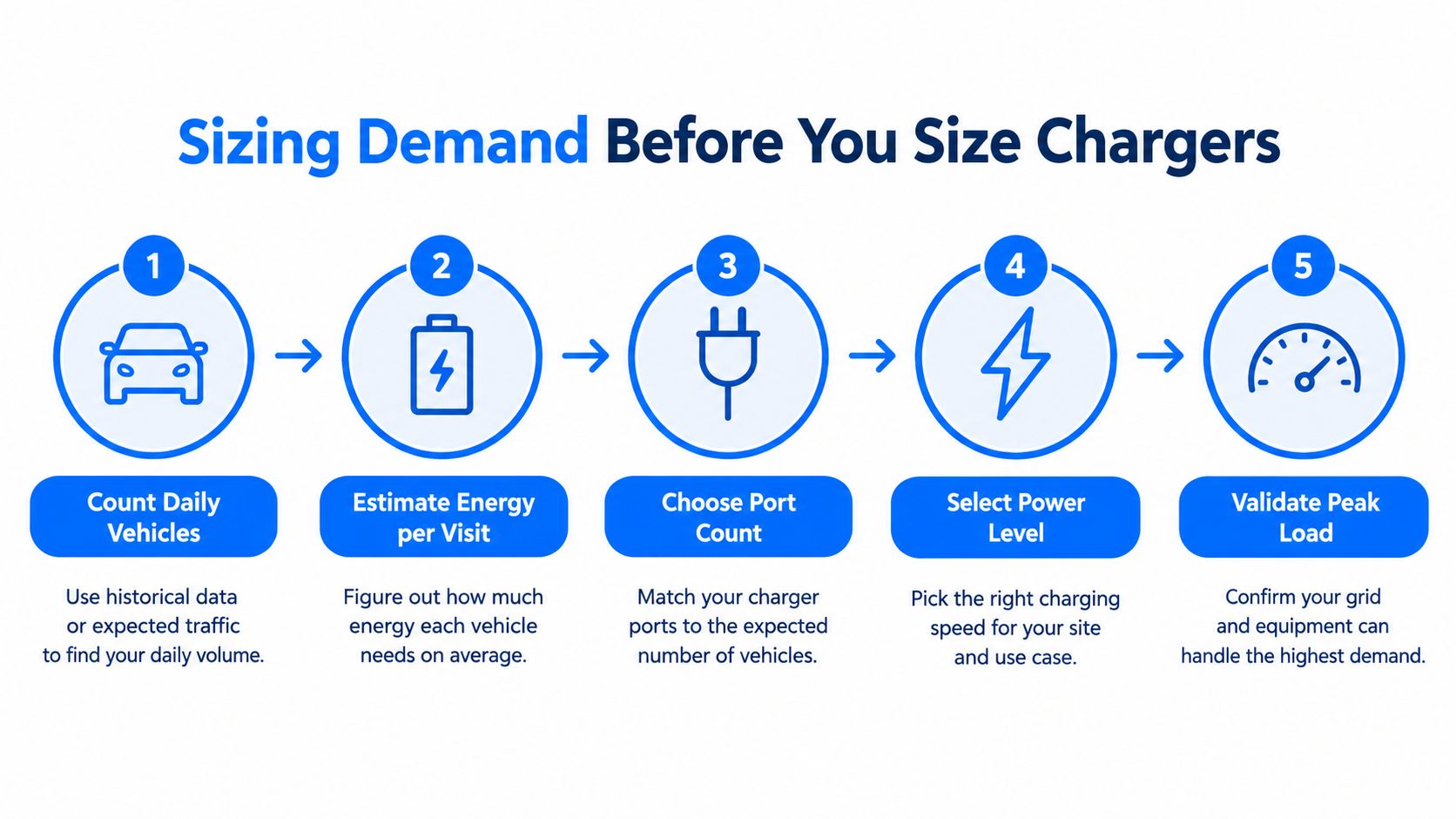
Use the answers to create a staged demand model:
Survey daily vehicles. Record likely arrivals, departures, charging days, and dwell times.
Estimate energy per visit. A commuter parked through the workday has a different requirement from a customer making a short retail stop.
Choose port count. More ports improve access and reduce waiting, but they do not mean every vehicle needs full power simultaneously.
Select power level. Match charging speed to parking duration, vehicle turnover, and the available electrical capacity.
Validate peak load. Compare unmanaged charging with a controlled schedule and the building's measured load profile.
One workplace study found that 64% of drivers preferred 22-kilowatt chargers, while measured parking and travel patterns indicated that 7-kilowatt or 11-kilowatt charging could often satisfy daily energy needs. The figures appear in the commercial building charging guidance from ENERGY STAR. Preference helps define the user experience, but parking duration and delivered energy determine whether the electrical design works.
Turn survey answers into a load model
The useful output is a schedule, not a wish list of charger models. Document likely arrivals, departures, energy requirements, and the maximum charging power that can be allocated throughout the day. Record the building's interval load, model charger power against dwell time, compare unmanaged and controlled scenarios, and reserve capacity for expansion.
The resulting design may use more ports at lower power, fewer higher-power ports, or a combination. Parking duration often gives controls enough time to spread charging across the day, avoiding a service design based on every connector operating at full output together.
An electrical load assessment and calculation review can document the assumptions behind the model before equipment is ordered. That record also gives the owner a clear basis for revising the deployment when tenant demand, fleet schedules, or operating hours change.
Panel Upgrades, Service Upgrades, and Managed Load
After the load model is complete, inspect the electrical path before choosing equipment. A small deployment may fit within verified spare capacity. Another site may need a new distribution panel, a service upgrade, or controls that keep charging within the building's operating limit. The lowest initial cost can leave little room for expansion, while the largest upgrade can add construction and utility work the site does not yet need.
Approach | Best Fit For | Main Limitation |
|---|---|---|
Reuse existing panel capacity | Small first deployments with verified spare capacity | Limited expansion and possible routing constraints |
Add a sub-panel | Sites with feeder capacity but limited local breaker space | Does not solve an undersized service or feeder |
Complete a service upgrade | Properties requiring sustained higher capacity or major expansion | More engineering, utility coordination, permitting, and construction |
Use managed load control | Sites where charging can be scheduled within available capacity | Requires controls, communications, commissioning, and defined fallback behavior |
Reuse, extend, or rebuild
Panel reuse is appropriate only when the service calculation and measured demand support the added load. The design still needs correctly sized overcurrent protection, conductors, disconnecting means, grounding, and a practical route to the charging equipment. Confirm those conditions before reserving panel space as available capacity.
A sub-panel can improve distribution when the main service has capacity but the existing panel is full, remote, or poorly positioned. It does not create capacity. If the feeder, transformer, or service is already constrained, a new enclosure only relocates the restriction.
A full service upgrade fits properties with sustained demand, a growing fleet, or a defined expansion program that managed charging cannot reasonably support. In older Southeastern Pennsylvania buildings, the utility controls much of the service and transformer process. The electrical contractor controls the building-side design, equipment, installation, documentation, and coordination. Utility review requirements still govern the schedule.
Use managed load deliberately
Managed charging assigns available power across vehicles while protecting a defined building limit. A controller can reduce charging output when HVAC or refrigeration demand rises, then increase it as capacity returns. That approach makes charging an operating-model decision, not only an equipment purchase.
The control sequence should begin with a site limit, charger priorities, and a response to changing building demand. It should then be tested under the conditions that expose weak designs: several vehicles arriving together, a failed connector, lost communications, a utility-limit event, and recovery after an outage.
The system needs a defined fallback state. Communications loss must not create an unsafe overload, and the owner should know whether chargers stop, reduce output, or follow a local limit when the controller is unavailable. Document those choices before commissioning.
Reserve the pathway even when you do not install the full system. Conduit routes, switchgear space, and communications capacity are difficult to add after paving, landscaping, or tenant improvements are complete.
For owners considering a broader commercial electrical service upgrade, a staged design may combine a modest initial installation with reserved infrastructure and controlled expansion. That sequence preserves capital while keeping the electrical plan aligned with actual vehicle demand and building capacity.
Site Layout, Accessibility, and Physical Usability
A charger can be electrically perfect and still fail the property's users. Drivers need to enter the space, reach the connector, see the controls, avoid traffic conflicts, and leave without dragging a cable across a walkway.
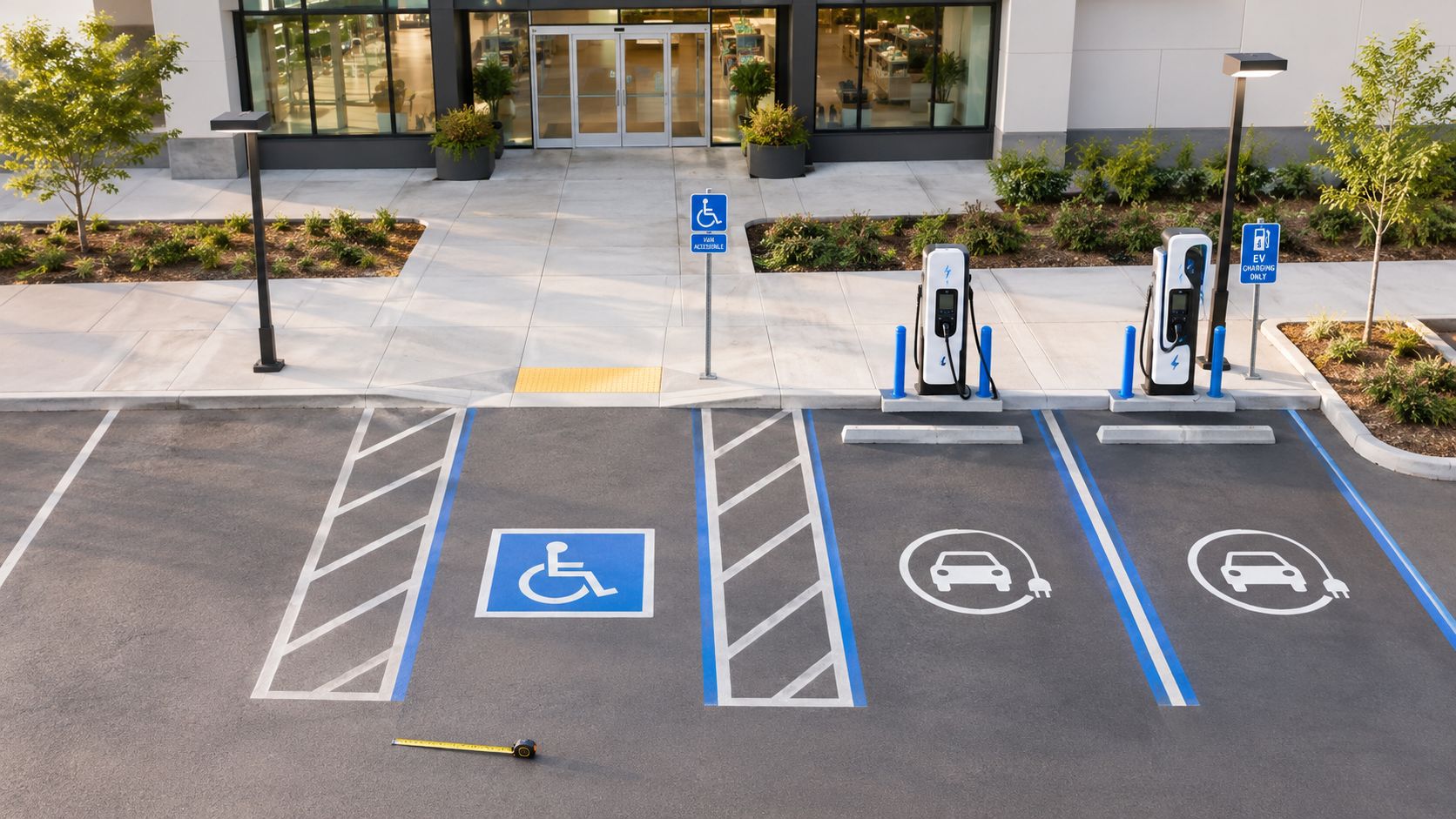
Begin with a scaled site plan. Mark building entrances, accessible routes, lighting, drainage, snow-removal paths, equipment clearances, transformer access, and the reach of every cable. Then walk the route in person. Drawings often miss a curb, bollard, loading pattern, or snow-storage area that becomes obvious on site.
Screen the physical installation
NYSERDA identifies power availability, accessibility, convenience, and adequate operating space as core charging-site factors in its commercial EV charging site-design guidance. Accessible charging areas should have no more than a 2% slope in any direction, according to that guidance.
At least the first accessible charger should be near an accessible entrance, on a firm, level, smooth surface. The design should also account for:
Cable reach: Confirm the connector can reach the vehicle inlet without crossing an accessible route.
Equipment protection: Use bollards or equivalent protection where vehicles could strike pedestals or wall-mounted equipment.
Drainage and snow: Keep equipment out of low spots and away from locations where plowed snow will block access.
Maintenance clearance: Leave room to open equipment, test disconnects, and service communications hardware.
Network coverage: Verify cellular or other approved connectivity where networked chargers will operate.
Poorly sized pathways and blocked equipment access are common post-installation problems. So are conduit routes that conflict with pavement drainage, parking enforcement, or seasonal snow storage.
Commission the user experience
Federal guidance requires compliance with applicable local and state codes and installation by a licensed electrical contractor. Physical commissioning should include more than turning on a screen. Test several vehicles, confirm cable reach, verify signage and payment or authorization behavior, and observe what happens when a driver parks incorrectly or leaves a vehicle connected after charging ends.
NREL workplace research indicates that perceived charger scarcity and network reliability influence charging behavior. That makes uptime, queue management, and clear access rules operating requirements, not decorative amenities. A charger that has high nameplate power but is frequently unavailable won't serve the property well.
Metering, Payment, and Who Actually Pays
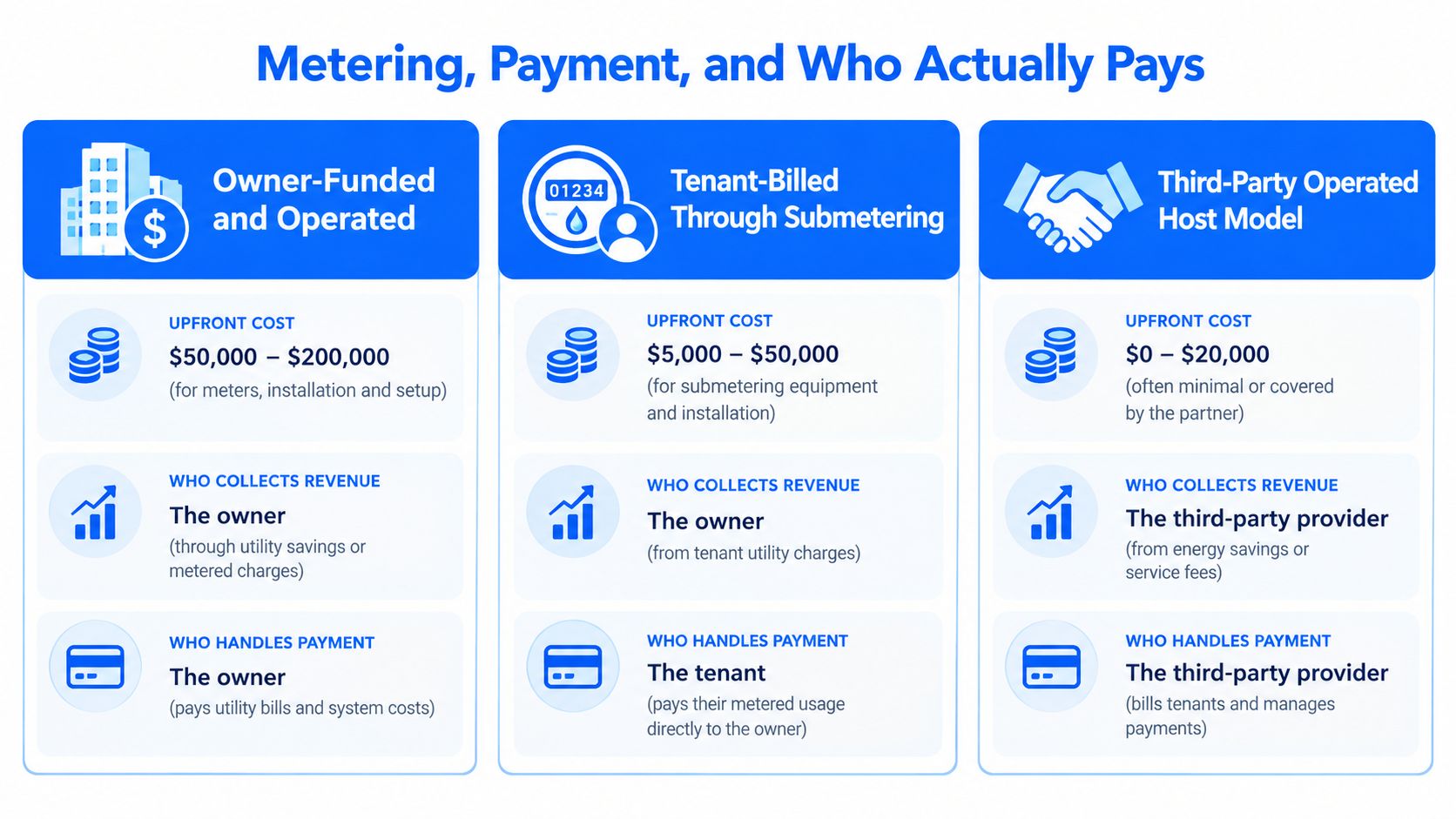
A charger can be technically reliable and still create an argument over the electricity bill. Before equipment is ordered, decide who owns the hardware, who pays for energy, who collects session revenue, and who absorbs costs when usage falls below expectations. Commercial properties commonly treat charging as a tenant amenity, recover costs from drivers, or lease the spaces to a third-party operator.
Build the financial model around electricity, demand charges, network services, payment administration, maintenance, repairs, and utility or transformer work. Knight Frank's 2025 EV property research identifies grid capacity as a consideration for charger installations and projects 30 terawatt-hours of additional electricity demand by 2030, compared with 300 terawatt-hours in 2020. Connection timing and available capacity therefore belong in the operating model, not just the electrical design.
Compare the ownership structures
Owner-funded and operated gives the property owner control over access, pricing, and the driver experience. The same owner carries the electricity bill, demand exposure, repairs, software administration, and payment disputes. It can suit a property where charging supports tenant retention or customer visits rather than producing direct revenue.
Tenant-billed through submetering assigns energy costs more directly to users. The owner still needs accurate metering, a defensible allocation method, suitable lease language, billing administration, and a method for handling common-area electrical costs. Submetering is not the same as a utility-approved dedicated meter. Document the electrical and legal arrangements before launch.
Employee-paid through a network shifts session payment to users and can simplify access control. It also creates transaction fees, account support, refunds, and connectivity obligations. Employees may pay for energy while the property owner still carries infrastructure and demand-charge risk.
Third-party operated host models can reduce the owner's daily workload. The contract should assign construction responsibility, utility upgrades, equipment ownership, maintenance response, revenue sharing, parking rights, data access, insurance, and removal obligations. Vague language usually becomes expensive when a charger fails or the utility requires extra work.
Public fast-charging utilization has been reported at about 16.2% in Q1 2025 and 16.4% in Q4, while destination charging lacks a comparable national dataset because site operating hours differ. Those figures should not be used to promise payback for an office or retail property.
The lowest-risk model assigns every cost to a named party. If the contract does not state who pays demand charges, failed payment hardware, cellular service, utility upgrades, and replacement parts, the owner may find out through an invoice.
Permitting, Installation, and Commissioning in the Right Order
Commercial charging projects stall when construction begins before the electrical and approval path is settled. The sequence should protect the design from avoidable rework.
Confirm the utility path first
Start with the proposed charger load, site service information, and a utility load-letter or new-load review where required. Ask the utility whether the existing service and transformer can support the proposed installation, whether a new meter or transformer is needed, and what documentation it expects.
Then submit the local permit package. Depending on the property and jurisdiction, the package may include a site plan, electrical plans, load calculations, equipment specifications, accessibility details, signage, and a one-line diagram. Zoning, parking, public-works, and fire reviews may apply to particular sites.
Installing equipment before utility confirmation is risky. If the utility requires load reduction, a new transformer, or a different service arrangement, the contractor may have to redesign equipment, feeders, disconnects, or trench routes.
Build, inspect, and activate
A licensed electrical contractor should install the system to the adopted code and manufacturer requirements. Federal guidance emphasizes that commercial installations must comply with local and state codes and be completed by a licensed electrical contractor.
Commissioning should document:
Voltage and phase checks: Confirm supply voltage, phase arrangement, rotation where applicable, and voltage under load.
Protection testing: Verify breakers, disconnects, ground-fault protection, emergency shutoffs where applicable, and protective-device operation.
Grounding verification: Confirm grounding and bonding continuity.
Network enrollment: Register chargers, confirm communications, and verify remote status reporting.
Payment and authorization: Test cards, accounts, access rules, pricing, receipts, and session termination.
Fault reporting: Confirm that a failed connector or communications outage creates the intended alert and safe fallback.
Vehicle testing: Run live sessions with multiple vehicles, including simultaneous charging and recovery after an outage.
Network enrollment and payment setup shouldn't be left to the property manager after the electrician leaves. The site isn't commissioned until a driver can arrive, authenticate, charge, receive the expected result, and report a fault through a known process.
Running the Site After the First Vehicle Charges
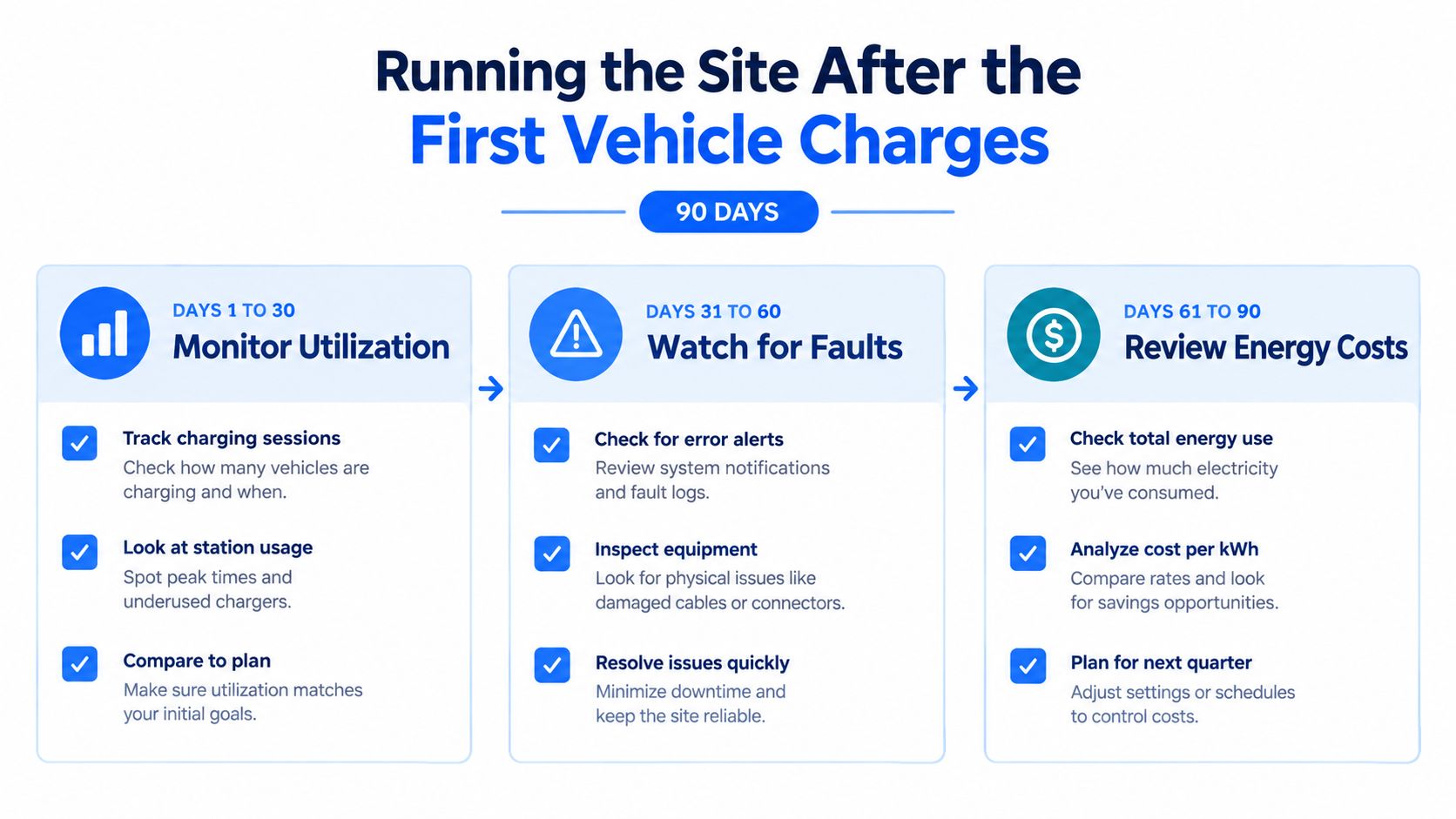
The first successful charging session is the start of operations, not the end of the project. During the first 90 days, monitor utilization, session failures, nuisance trips, demand peaks, user complaints, payment behavior, and network uptime.
Days 1 to 30 should establish the baseline. Days 31 to 60 should focus on recurring faults, access problems, and vehicles that remain connected longer than expected. Days 61 to 90 should compare actual energy costs and demand behavior with the original model.
Put these reviews on the calendar:
Quarterly: Check charger uptime, fault history, utilization, billing reconciliation, cable and pedestal condition, signage, and snow or drainage issues.
Annually: Recheck the building load profile, utility tariff and demand behavior, network contract, maintenance response, expansion capacity, and reserved conduit documentation.
Expand when the service model shows sustained demand, queues, or unmet fleet requirements, not merely because more parking spaces exist. Keep a record of every reserved breaker position, conduit stub, communications route, and switchgear allowance so the next phase starts with facts.
Amp'd Energy Solutions can assess commercial properties, evaluate panel readiness and load capacity, install EV chargers for workplaces, parking lots, apartments, and other business locations, and complete service upgrades when the existing electrical system can't support the plan. Visit Amp'd Energy Solutions to discuss a staged charging design that fits the property's electrical capacity and operating model.
Comments