

How Fast Does a Tesla Charge? Miles by Charger
A Tesla's advertised peak charging power does not tell you how quickly it will charge in every situation. The table below pairs model-specific estimates with the charging setup; actual rates depend on the battery's temperature, charge level, and available electrical power.
The practical measure is how much driving you need to replace before leaving again. A highway stop and an overnight charge serve different needs, so match the charging setup to your parking time.
Table of Contents
Tesla Charging Speeds at a Glance - Read the column that matches your parking time - Range added isn't battery percentage
How Charger Power Becomes Miles - AC charging uses equipment inside the car - Power becomes energy, then driving range
Why the Rate Rises and Then Falls - A cold battery changes the starting conditions - Separate battery limits from station limits
Home Circuits That Set the Overnight Rate - The breaker rating isn't the charging setting - Match the installation to the daily deficit
What a Commute and a Road Trip Actually Take - The driveway session - The highway session - Estimate your own session
Choose Home or Road Charging and Check the Panel - Avoid buying speed you can't use - Check the panel before ordering equipment
Tesla Charging Speeds at a Glance
A Tesla's charging speed depends on both the charging equipment and the vehicle. The table separates miles added during a short Supercharger stop from the approximate miles added per hour at home.
Vehicle | V3 Supercharger miles in 15 min | 48A Wall Connector miles per hour | 32A home miles per hour |
|---|---|---|---|
Model 3 | 175 | 44 | About 30 |
Model Y | 162 | 44 | About 30 |
Model S | 200 | 41 | Lower-current AC rate set by the vehicle |
Model X | 175 | 35 | Lower-current AC rate set by the vehicle |
Cybertruck | 137 | 30 | Lower-current AC rate set by the vehicle |
Tesla's Supercharging guidance gives the V3 estimates above and lists peak power of up to 250 kW. These are favorable-condition figures. Home rates are approximate, and the car's charging hardware and electrical circuit affect what it can accept.
Read the column that matches your parking time
Read miles added for a short stop and miles per hour for overnight parking. The figures answer different planning questions: how much range a brief stop may add, or how much range home charging may provide while the car is parked.
Model 3 and Model Y share the same listed home estimates, though their Supercharger figures differ. Model S has the largest listed short-stop estimate, while Model X's is lower than Model 3's. Use the row for your vehicle rather than assuming another model will charge at the same rate.
At home, a lower-current circuit does not produce one universal figure across all Teslas. The vehicle's AC charging hardware and the circuit both shape the rate, so the table gives a specific estimate only where one is available.
Range added isn't battery percentage
Added miles describe estimated driving range, not a fixed share of the battery. Battery capacity, vehicle configuration, and energy use affect how much range a given amount of electricity adds.
Supercharger estimates also describe a favorable part of a session, not a constant rate from empty to full. Starting charge level, battery temperature, and ambient conditions affect how quickly the car accepts power.
Choose the right measure: Use miles added during a brief stop for travel planning, and miles added per hour for a car that can remain parked.
For home equipment, focus on whether the circuit can supply enough range during the hours the car is parked. The largest Supercharger figure does not determine the overnight rate.
How Charger Power Becomes Miles
Say you arrive home, plug in, and leave the car until morning. You don't need the battery filled immediately. You need the available charging time to replace the energy you used.
Charging resembles filling a tank through different hoses: a household outlet is a trickle, home AC charging is a garden hose left running for hours, and DC fast charging is a powerful burst used during a short stop. The analogy explains the timing, but the electrical path explains why the rates differ.
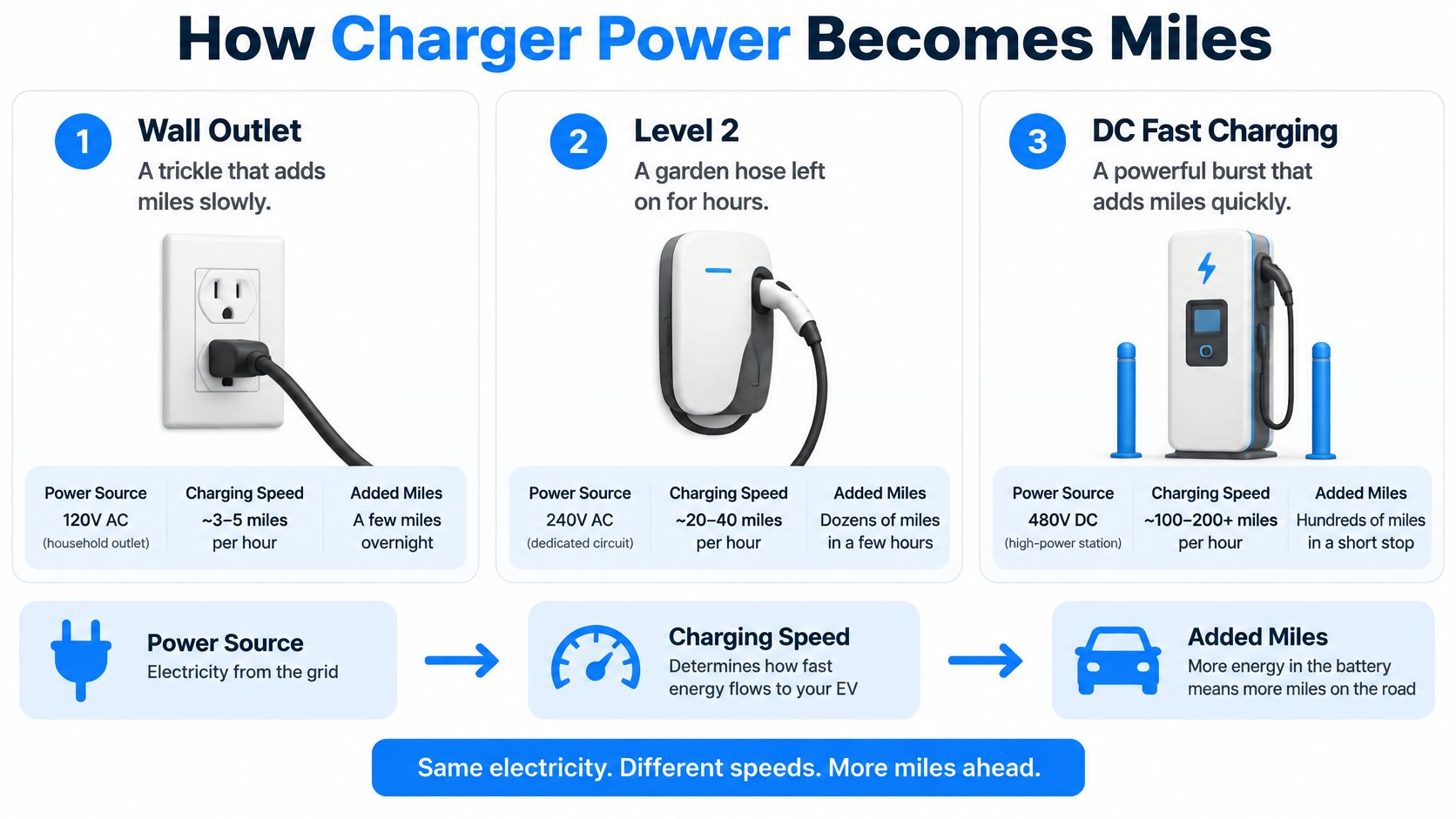
AC charging uses equipment inside the car
Household and dedicated home charging supply alternating current, or AC. The vehicle's onboard charger converts that electricity into the form the battery can store. The wall equipment makes power available safely, but it can't force the car to accept more than its onboard charger allows.
That distinction also applies to Destination charging at hotels and similar properties. A convenient parking location doesn't turn AC equipment into a Supercharger. For a closer look at the supply side, our guide to Level 2 charger voltage explains how the electrical connection fits into the installation.
DC fast charging takes a different path. The charging station performs the conversion outside the car and supplies direct current to the battery, bypassing the onboard AC charger. The vehicle still controls how much power it accepts.
Power becomes energy, then driving range
A kilowatt describes the rate of energy transfer. A kilowatt-hour describes an amount of energy. Holding a charging rate for longer transfers more energy, but not all incoming energy becomes additional driving range.
The conversion is easier to understand as a sequence:
Available electrical power: The supply and charging equipment establish what could reach the car.
Accepted charging power: The vehicle limits that supply according to its hardware and battery conditions.
Usable driving range: Charging losses, battery heating, cabin conditioning, and vehicle efficiency affect the miles you gain.
Battery size alone doesn't determine miles added per hour. A larger battery takes more energy to fill through the same percentage, while a less efficient vehicle needs more energy to travel the same distance.
For home and lodging stays, think in miles per hour of charging. For DC stops, think in miles added during the stop, with enough reserve for the next leg. Neither measure is improved by confusing the charger's maximum output with the car's actual intake.
Why the Rate Rises and Then Falls
A Tesla doesn't accept maximum charging power throughout a session. At a low or moderate state of charge, the battery can generally accept energy faster; as it fills, the vehicle reduces power. That slowdown is called charging taper.
A session can therefore begin below its eventual peak, rise as the battery reaches suitable conditions, and then fall as the pack fills. The highest number on the screen is only a moment in that session. Your elapsed time reflects everything before and after it.
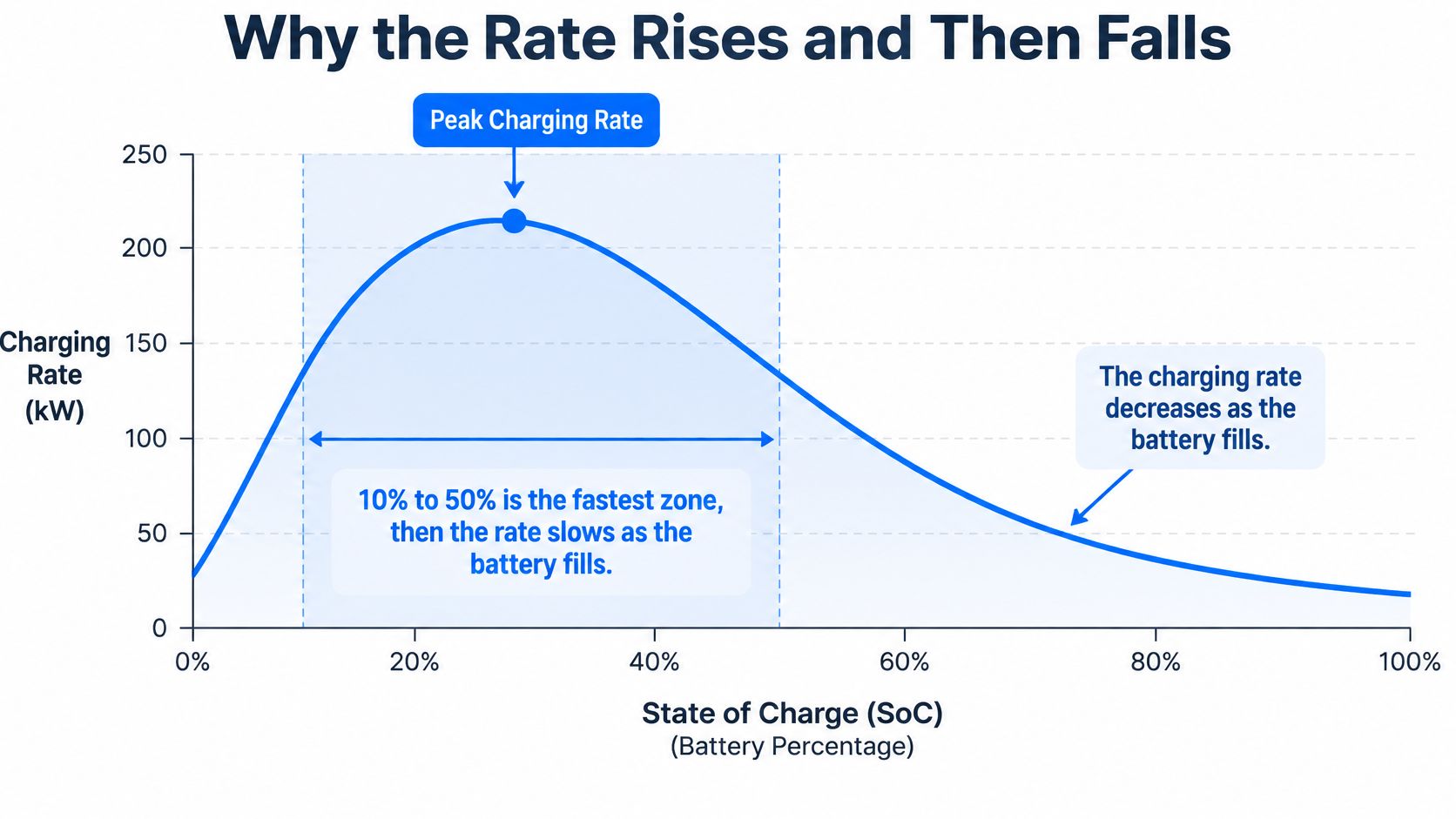
A cold battery changes the starting conditions
Winter creates separate problems: the car may have less available driving range, and the battery may initially accept charging power more slowly. In its buyer guide, Cars.com, citing Recurrent, reports an average 20% temporary range loss when temperatures fall from 68–74°F to 32°F.
That finding describes range loss, not an identical reduction in charging speed. Charging power has its own temperature controls. The battery-management system can restrict incoming power until the pack reaches a suitable temperature.
For a Southeastern Pennsylvania winter trip, that means a powerful charging stall can't by itself overcome a cold battery. Enter the fast charger in the car so it can prepare the battery. Preconditioning addresses the battery's readiness rather than merely increasing the power available outside it.
Separate battery limits from station limits
A slow session doesn't always mean something is broken. Before drawing a conclusion, identify what the vehicle and station are doing.
A cold arrival: The vehicle may spend part of the stop warming the battery before accepting higher power.
A nearly full pack: The vehicle deliberately reduces charging power as available capacity shrinks.
Temperature outside the preferred range: The battery's thermal-management system may need to heat or cool the pack.
Limited station delivery: Site conditions, equipment limits, or power sharing on applicable equipment can constrain available output.
At home, charging usually has a longer window. The car can warm gradually and replenish the daily deficit without requiring a brief peak. A scheduled departure can also help coordinate charging and cabin preparation with your departure time.
Don't choose a universal daily charge limit solely to avoid taper. Follow the recommendation for your specific vehicle and battery, then adjust for the next day's driving.
Judge a charging stop by useful range gained before departure, not by the largest power reading that briefly appears.
A larger home charger won't remove a battery-temperature limit. It also won't correct a house whose electrical capacity requires a lower configured current. Those are different constraints, and each needs its own solution.
Home Circuits That Set the Overnight Rate
A home charger's current depends on the circuit and how the equipment is configured. For example, a 40-amp circuit can support 32 amps of continuous charging current when the installation is designed for it. The earlier comparison table shows how that translates into estimated charging speed; the figures are typical, not a promise that every car will hold the same rate.
Breaker | Charger current | Power | Model 3 and Y miles per hour |
|---|---|---|---|
60 amp | 48 amp | 11.5 kW | 44 |
50 amp | Set by approved equipment and circuit design | Calculated from supply voltage and configured current | Estimate from the vehicle's accepted AC rate |
40 amp | 32 amp | 7.7 kW | About 30 |
Household outlet circuit | Set by receptacle, equipment, and circuit rating | Limited by the approved outlet setup | Slow replenishment suited to a small daily deficit |
For an ordinary household outlet, the receptacle, circuit, charging equipment, and vehicle all affect the rate. That is why one typical figure cannot describe every outlet setup.
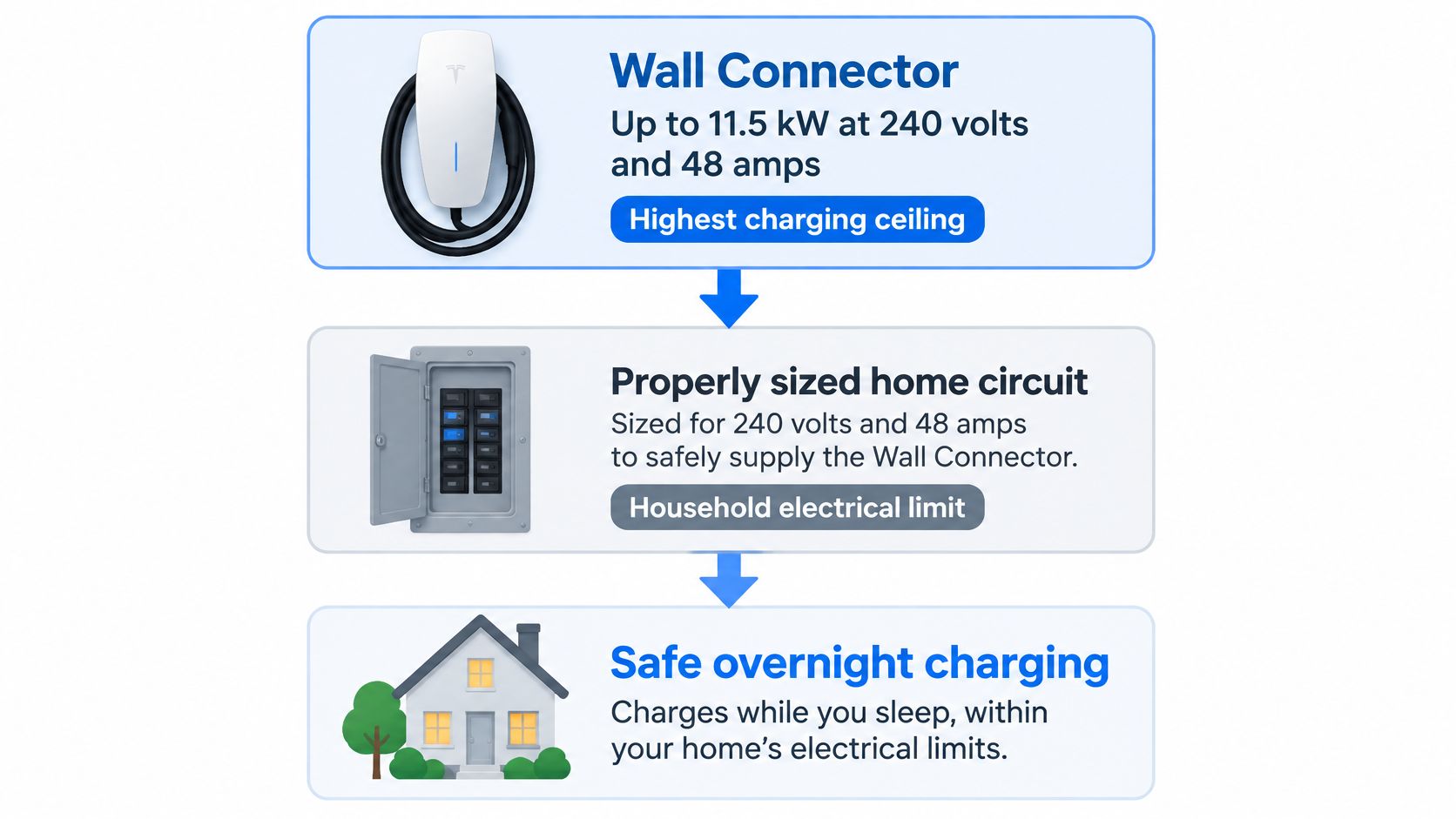
The breaker rating isn't the charging setting
EV charging draws current continuously, so the entire circuit must support sustained use. The breaker, conductors, terminations, charger configuration, and available panel capacity all factor into the approved current.
The charger's configured current must be matched to the circuit's approved capacity. This guide to Level 2 EV charger amps explains how circuit capacity and configured current relate.
An electrician should assess the route from the panel to the charger, including conductor sizing, installation method, connection ratings, and wire-run length. A tidy wall-mounted unit alone doesn't show whether the wiring behind it supports the intended output.
Match the installation to the daily deficit
Choose a home setup based on whether it can replace your usual driving before the next departure, while allowing for weather and occasional longer days. The goal is a suitable overnight rate, not the shortest possible time to fill an empty battery.
Check these constraints before choosing an output:
Existing household demand: Heating and cooling, cooking appliances, a dryer, and workshop equipment affect available capacity.
Panel condition and configuration: Spare breaker spaces don't establish whether the electrical service can support another sustained load.
Cable route: A long or difficult route can affect installation design and conductor selection.
Vehicle acceptance: The car may impose a lower AC charging limit than the wall equipment can offer.
A lower-current dedicated circuit may suit a car that stays parked long enough. If the charging schedule and household demand cannot fit within the available capacity, an electrical service upgrade may be appropriate.
Installation rule: Configure the charger to the circuit's approved capacity, not the highest setting available in the app.
Replacing a breaker with a larger one does not solve a capacity problem. The conductors and the full installation must support the design.
What a Commute and a Road Trip Actually Take
Consider a Model Y owner in Southeastern Pennsylvania who plugs in after dinner. The car isn't empty; it needs to replace the day's driving. With a suitable dedicated circuit, that can leave most of the overnight parking window unused.
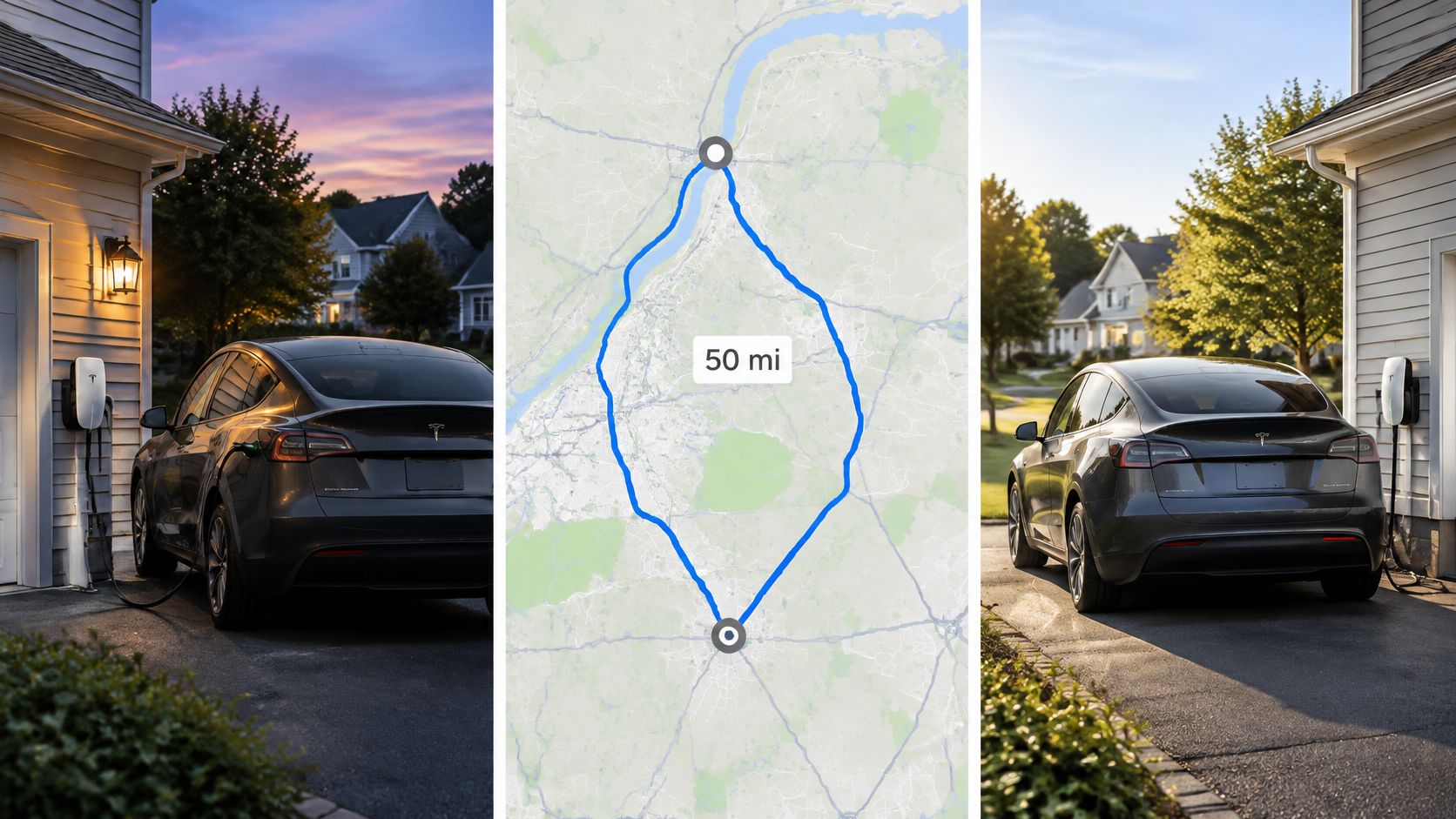
The driveway session
The owner sets a departure schedule and a vehicle-appropriate charge limit. Charging can finish before morning without requiring anyone to wait beside the car. The practical benefit isn't instantaneous charging; it's having the required range ready while the driver does something else.
Now consider the same routine on a lower-current circuit. The session lasts longer, but that doesn't necessarily change departure readiness. If both installations finish during the available parking window, the larger circuit may offer convenience for unusual days rather than a meaningful improvement every morning.
For either setup, leave some flexibility for winter preparation and extra errands. Planning exactly to the minute leaves no room for a colder battery or a later arrival home.
The highway session
On a road trip, waiting time matters directly. In 2025, Kelley Blue Book reported that charging a Tesla to 80% generally takes 15–20 minutes with a 250-kW Supercharger, while a 150-kW charger can take up to 40 minutes.
Those are general estimates, not a specified starting-charge guarantee for every Tesla. A cold-soaked vehicle, an already well-filled battery, or a different configuration can change the result. Let the vehicle's route planner and live charging estimate guide the actual stop.
The driver should decide what the next leg requires, including a sensible arrival reserve. Waiting for a completely full battery may add time without improving the journey, while leaving too early can create an unnecessary second stop.
A workplace session follows the driveway logic rather than the highway logic. If the vehicle remains parked through a work shift, moderate AC power can cover the driving deficit without a separate fast-charging visit. Shared workplace equipment does require realistic expectations about access and how long each vehicle occupies a space.
Estimate your own session
Use a simple home-planning formula:
Charging hours ≈ miles you need to replace ÷ expected miles added per hour.
Use the rate your vehicle and installed circuit can sustain, then allow for temperature and charging losses. For a highway stop, use the car's predicted departure time instead of applying a constant hourly range figure to a changing DC charging curve.
Choose Home or Road Charging and Check the Panel
Start with the parking schedule: how long will the car already be sitting still? A driveway, employee parking space, or overnight lodging stay gives AC charging time to do its job. A brief travel break requires a different kind of equipment.
The best setup doesn't always provide the highest instantaneous power. It provides enough energy by departure without creating an electrical-capacity problem or adding unnecessary stops to your routine.
Charge where the car already waits; fast-charge when the clock is short.
Avoid buying speed you can't use
A home charger's advertised maximum isn't a promise that your property or vehicle can use it. Buying higher-rated equipment doesn't automatically shorten charging if the approved circuit configuration remains lower.
Likewise, a hotel Destination charger can be useful even beside a busy fast-charging location. If you won't leave until morning, a slower session may be the better match. Check access, parking rules, connector compatibility, and whether charging is available throughout your stay.
Avoid these mismatches:
A fast stop for an overnight need: A separate charging trip can consume time that parked charging would otherwise use.
A high-output charger on a constrained installation: The equipment must still operate within the circuit's approved limits.
A full battery as the default goal: Choose a charge target that follows your vehicle's guidance and supports the next drive.
A workplace plan based only on equipment count: Consider employee parking duration, access, and whether vehicles must move after charging.
For business properties, charging requirements should follow actual use. Employee vehicles parked through a shift have different needs from customer vehicles making short visits. Define that use before deciding how much electrical capacity to allocate.
Check the panel before ordering equipment
A practical electrical assessment starts with the home's existing system, not a charger shopping cart.
Identify the service and major loads. Read the accessible service labeling and list large appliances, heating and cooling equipment, and planned additions. Don't remove the panel cover to inspect energized components yourself.
Describe the charging requirement. Bring your typical driving distance, departure time, parking location, and vehicle configuration. Include irregular demands, such as late arrivals followed by early departures.
Confirm a safe circuit design. A licensed electrician should determine available capacity, conductor requirements, overcurrent protection, and the charger configuration. If capacity is tight, compare a lower charging current with an appropriate service upgrade.
A panel with empty spaces can still lack usable capacity. Conversely, a panel that looks crowded doesn't automatically require replacement. An electrical load assessment provides a sound basis for that decision instead of relying on appearance.
At Amp'd Energy Solutions, our electricians are licensed, and we're a Tesla-certified installer serving Southeastern Pennsylvania. A site assessment can establish whether the proposed charging location and electrical system fit the intended charging routine before equipment is ordered.
The result you want is specific: an approved circuit, a correctly configured charger, and enough range ready at departure. That's a more useful definition of fast home charging than the highest number printed on the equipment.
Amp'd Energy Solutions offers home and workplace EV charger installations, dedicated circuits, and electrical service upgrades to support dependable charging. Visit Amp'd Energy Solutions to request a site assessment and have our licensed electricians check your panel capacity, wiring route, and charging requirements before you choose your installation.
Comments