

Best Level 2 EV Charger for Home: Top Picks for 2026
You've chosen an EV, but the home-charging decision can still feel surprisingly complicated. One charger promises maximum output, another emphasizes solar integration, and a third offers flexible amperage for an older electrical system. The best Level 2 EV charger for home use depends on more than the box on the wall. Your vehicle's onboard charger, available panel capacity, installation location, WiFi coverage, weather exposure, and plans for solar or battery storage all matter.
A panel-readiness assessment should come before choosing a 30-, 40-, or 48-amp setup. The charger can't deliver more power safely than the dedicated circuit, service, and vehicle can support. The SAE J1772 standard supports 208 to 240 volts and up to 80 amps for Level 2 AC charging, but residential performance is usually constrained by the electrical panel and the vehicle's onboard charger.
This roundup organizes the choices around real homeowner priorities, including electrical capacity, smart energy control, durability, connectivity, and driving habits. In Southeastern Pennsylvania, Amp'd Energy Solutions can assess the home, install a dedicated circuit, complete a service upgrade when needed, and coordinate EV charging with Powerwall or broader home-energy projects.
Table of Contents
2. Wallbox Pulsar Plus - A practical solar and load-management choice - Installation details that affect performance
3. ChargePoint Home Flex - Useful for upgrade-ready homes - What to ask before installation
4. Eaton Wall-Mounted Level 2 Charger - A dependable choice for uncomplicated installations
5. Grizzl-E Classic 40-Amp Level 2 Charger - Durability with fewer digital obligations - Who should choose it
6. EVgo Home Fast Charging Station - Best for drivers with a wider travel pattern - Energy integration and location
7. JuiceBox Pro 40 Smart Level 2 Charger - Smart features need a clear energy plan
8. Siemens VersiCharge Smart Level 2 Charger - Load balancing and diagnostics - Where it makes the most sense
1. Tesla Wall Connector
The Tesla Wall Connector is a strong fit for Tesla owners who want a polished, permanently mounted charger with high output and native ecosystem integration. It can deliver up to 11.5 kW at 48 amps, matching the upper end of common residential Level 2 charging. That output only helps when the vehicle and home electrical system can accept it, so the installation plan matters as much as the product specification.
Tesla's app integration makes remote monitoring and scheduling straightforward. A homeowner can use scheduled charging to avoid unnecessary daytime operation and coordinate charging with household energy priorities. For a Tesla household that already uses Powerwall, keeping the charger and battery system within a coordinated installation plan can simplify energy management.
Best fit for Tesla-centered homes
The Wall Connector makes the most sense when the household owns one or more Tesla vehicles, wants a clean permanent installation, and has enough electrical capacity for a dedicated circuit. It can also support other EVs when configured with the appropriate connector arrangement, but buyers should confirm compatibility before ordering.
Practical rule: Treat the requested charger output as a design target, not a guarantee. The circuit, panel, and vehicle determine what the car will actually receive.
Plan for the electrical assessment before committing to a high-output installation. A 48-amp continuous load generally requires planning around a 60-amp circuit, and the home may need load management or a service upgrade. Amp'd Energy Solutions can also help plan conduit routing so future servicing or energy-system changes don't require unnecessary wall disruption. Review the EV charger installation planning guide before scheduling the work.
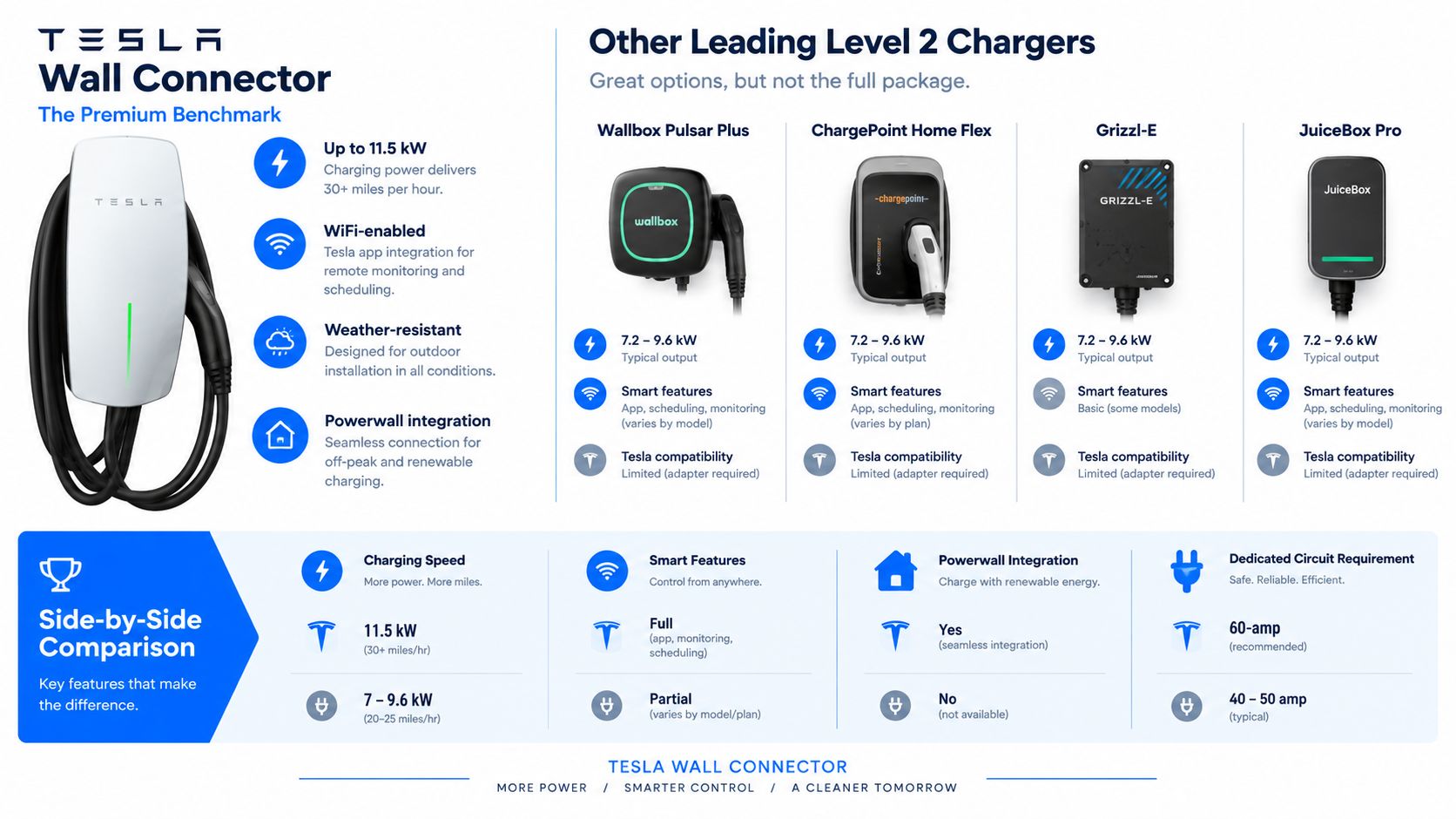
2. Wallbox Pulsar Plus
The Wallbox Pulsar Plus suits homeowners who want charging hardware to participate in a broader energy-management strategy. Its planned configuration delivers 7.4 kW at 32 amps, which is below the maximum output of the highest-powered home units but remains well suited to overnight replenishment for many daily drivers. Choosing that lower output can also reduce pressure on a constrained panel.
Its value comes from connected control and load-management capabilities. WiFi access enables scheduling, monitoring, and remote control, while energy-management features can help coordinate charging with other household loads. That matters in homes where an EV shares capacity with electric heating, a heat pump, an electric range, or another high-demand appliance.
A practical solar and load-management choice
Wallbox is especially appealing for a solar-equipped home. Scheduling can align charging with available solar production when the household's energy system supports that approach. The charger won't create solar savings by itself, however. The electrician still needs to verify the panel, circuit, communications, and any load-management equipment during design.
For a multi-EV household, dynamic load balancing may be more valuable than maximum amperage. It can help keep charging within the home's available capacity instead of automatically assuming that a service upgrade is the only solution. That makes the Pulsar Plus worth considering during new construction or renovation planning, when conduit and future circuits are easier to coordinate.
Installation details that affect performance
Install the unit where the WiFi signal is dependable, or plan for a connectivity solution before relying on app features. An exterior installation also needs suitable mounting and protection from direct weather exposure. Amp'd Energy Solutions can assess whether the existing service supports the selected operating mode and whether load management is appropriate.
3. ChargePoint Home Flex
The ChargePoint Home Flex is a sensible option for homeowners who want flexibility as their electrical situation changes. Its dual-mode approach can operate at 32 amps or 16 amps, allowing the installer to match charging demand to the available circuit and panel capacity. That makes it particularly useful in an older home where the desired charging speed and the immediately available electrical infrastructure don't line up.
Starting at a lower setting isn't a failure. If the vehicle sits overnight and the household's daily driving is moderate, a lower-amperage configuration may meet the practical need without forcing an immediate panel expansion. The homeowner can then revisit the circuit or service capacity later if driving habits change or a second EV arrives.
Useful for upgrade-ready homes
The Home Flex works well when the installation needs a staged plan. An electrician can evaluate the current service, install appropriate wiring and protection, and determine whether future capacity can be added without replacing work that was just completed. That future pathway needs to be designed at the beginning. A later amperage increase isn't just an app setting if the circuit and conductors weren't sized for it.
ChargePoint's app adds scheduling and charging management. Those controls can help homeowners coordinate charging with utility periods when applicable, but connectivity is part of the installation experience. Test the signal at the proposed mounting point instead of assuming that garage WiFi will be reliable.
What to ask before installation
Ask Amp'd Energy Solutions to document the current operating mode, the circuit design, and the conditions required for a future increase. Outdoor mounting also requires careful attention to weather exposure and cable placement, especially in Pennsylvania winters. The home EV charger installation cost guide can help frame the conversation around equipment, wiring, labor, and potential electrical upgrades.
4. Eaton Wall-Mounted Level 2 Charger
The Eaton Wall-Mounted Level 2 Charger is aimed at homeowners who value straightforward operation and durable electrical equipment over a large software ecosystem. Its planned output is 7.2 kW at 30 amps, making it a moderate-power choice for overnight home charging. That output can be enough for a daily driver that returns home regularly and doesn't need rapid recovery between trips.
The appeal is simplicity. There's less dependence on an account, app, or cloud connection, so the charger can continue to serve its basic purpose without asking the homeowner to manage another software platform. For a rental property, a workshop, or a household that prefers physical controls, that can be a meaningful advantage.
A dependable choice for uncomplicated installations
Eaton is a logical candidate when the electrical system is mature, the installation location is predictable, and the owner wants equipment that standard electrical contractors can understand and service. It can work especially well in a protected garage. For outdoor use, select a suitable weatherproof enclosure or mounting arrangement and keep the charging connection away from direct water exposure.
The trade-off is reduced connected functionality. If you want automatic scheduling, energy dashboards, solar coordination, or tariff-based control, this isn't the natural first choice. You may need a separate timer or another home-energy control method, and those additions can make a simple installation less simple.
The right charger isn't always the one with the most features. A stable, properly installed unit can be more useful than connected hardware you won't use.
Before purchase, confirm the vehicle connector, circuit requirements, mounting surface, and service access. If the home may add battery storage, electric heating, or another EV later, include those future loads in the assessment rather than sizing the circuit only for today's equipment.
5. Grizzl-E Classic 40-Amp Level 2 Charger
The Grizzl-E Classic 40-Amp Level 2 Charger targets homeowners who want dependable charging without WiFi or software dependencies. Its planned output is 9.6 kW at 40 amps, giving it more capacity than a moderate 30-amp unit while avoiding the highest circuit demand associated with a 48-amp installation.
That combination suits rural properties, garages, and homeowners who prefer a plug-in-and-charge routine. You don't need an app to start a session, and you aren't depending on a cloud service for the basic charging function. Manual scheduling remains possible through household controls, utility settings, or a separate timer, but it won't provide the same integrated experience as a connected energy-management charger.
Durability with fewer digital obligations
The Classic's heavy-duty construction makes physical installation quality especially important. Mount it in a garage or on an exterior wall protected from direct rain spray, snow buildup, and accidental impact. A durable enclosure can't compensate for poorly routed cable, an unsuitable receptacle, or water entering the connection point.
A 40-amp operating level requires a properly sized circuit and panel review. Amp'd Energy Solutions can verify whether the home is ready for that load and whether a 50-amp circuit is appropriate for the planned installation. If the panel lacks capacity, load management or a service upgrade may be a better answer than forcing the charger into an unsuitable circuit.
Who should choose it
Choose Grizzl-E when you value mechanical simplicity, physical resilience, and long-term serviceability more than app features. It isn't the best match for a homeowner whose main goal is automated solar charging or detailed energy reporting. It is a strong practical fit for someone who wants to plug in after arriving home and let the vehicle charge without maintaining another connected device.
6. EVgo Home Fast Charging Station
The EVgo Home Fast Charging Station is a premium Level 2 option for drivers who want their home equipment connected to a broader charging routine. It can provide up to 11.5 kW at 48 amps, subject to the vehicle, circuit, panel, and installation design. Its differentiator is the relationship between home charging and EVgo's public charging network.
That network connection can be useful for commuters and regional travelers who alternate between charging at home and charging away from home. App-based controls, energy monitoring, and charging-management features can give tech-oriented owners a clearer view of when and how the vehicle charges. Those tools are most valuable when the homeowner uses them to schedule sessions and review energy behavior.
Best for drivers with a wider travel pattern
A driver who regularly takes longer regional trips may appreciate having home charging and public-network planning in one digital environment. The home charger still needs to carry the daily routine, while public charging remains a travel tool rather than a substitute for a properly designed residential circuit.
The high-output installation requires careful planning. A 48-amp charger commonly calls for a 60-amp circuit, and the panel may need load management or additional capacity. The charger's software won't solve an undersized service. It can manage charging behavior only after the electrical installation has been designed safely.
Energy integration and location
A garage or protected exterior location is preferable, especially where winter weather and direct precipitation affect the mounting area. If the property has a Powerwall or may add one, discuss the interaction between charging and backup power before installation. Charging an EV from stored battery energy can materially affect backup duration, so the control strategy should be explicit rather than assumed.
7. JuiceBox Pro 40 Smart Level 2 Charger
The JuiceBox Pro 40 Smart Level 2 Charger is designed for homeowners who want the EV to participate in an energy ecosystem rather than function as an isolated appliance. Its planned output is 9.6 kW at 40 amps, while its connected features focus on scheduling, solar compatibility, energy monitoring, and coordination with battery systems.
That combination makes it attractive to solar homeowners and people who already use connected home-energy equipment. Time-of-use scheduling can move charging into periods that better match local utility programs, while solar coordination can help align vehicle demand with renewable production when the system supports it.
Smart features need a clear energy plan
The app is valuable only when the homeowner has a specific operating strategy. Decide whether the priority is charging from solar production, using stored battery energy, avoiding high-rate periods, or ensuring the vehicle reaches a target state of charge by a departure time. A smart charger can follow that strategy, but it doesn't replace proper system design or utility-rate verification.
Energy-planning insight: Smart charging should reduce unnecessary demand, not encourage you to buy a larger circuit than your household actually needs.
Positioning near the main panel can simplify circuit routing and monitoring. It can also reduce installation complexity, although the ideal location still depends on parking, cable reach, wall construction, and weather exposure. If you're adding a Powerwall or planning solar, coordinate the EV circuit with the rest of the project instead of treating it as a separate appliance.
Before choosing this model, confirm current software support, vehicle compatibility, communications requirements, and the way the installation will handle outages. The Level 2 EV charging cable guide provides useful context for connector and cable decisions.
8. Siemens VersiCharge Smart Level 2 Charger
The Siemens VersiCharge Smart Level 2 Charger is suited to homeowners who want professional-grade equipment with connected diagnostics and load-management capability. Its planned output is 7.2 kW at 30 amps, giving it a moderate electrical footprint while retaining smart control. That balance can work well in a home with complex electrical demands or a property where diagnostic visibility matters.
A lower-power charger isn't automatically a compromise. If the vehicle is parked overnight, consistent operation may matter more than peak output. Siemens becomes particularly interesting when the installation needs careful coordination with other loads, future conduit, or multiple charging locations.
Load balancing and diagnostics
Load balancing can help the charger respond to the home's available electrical capacity instead of operating as though it has unlimited access to the panel. The electrician needs to configure that feature correctly, confirm the communications path, and test the system under realistic household conditions.
Diagnostic alerts can also make troubleshooting more structured. The homeowner may be able to identify a charging interruption or performance issue before it becomes a recurring morning problem. That benefit depends on reliable connectivity and proper commissioning, so the installation should include a clear handoff explaining the alerts and controls.
Where it makes the most sense
Consider Siemens when the property owner values electrical engineering, monitoring, and serviceability but doesn't need the maximum residential output. Use suitable conduit and leave a practical path for future capacity changes if the home may add another EV, battery storage, or other high-demand equipment. The final selection should follow the load calculation, not precede it.
Top 8 Level 2 Home EV Chargers Comparison
Product | Implementation complexity | Resource requirements | Expected outcomes | Ideal use cases | Key advantages |
|---|---|---|---|---|---|
Tesla Wall Connector | High, licensed electrician required, professional 240V install | 60 A dedicated 240V circuit, WiFi/Tesla app, panel capacity (Powerwall optional) | Fastest residential charging (~11.5 kW; ~30+ mi/hr), advanced scheduling and load management | Tesla owners, multi‑vehicle households, Powerwall-integrated homes | Highest output, seamless Tesla/Powerwall integration, premium build |
Wallbox Pulsar Plus | Medium, flexible wiring and simpler install with load management | 32 A/240V (or lower with dynamic load balancing), WiFi, solar integration options | Reliable mid-range charging (~7.4 kW), intelligent load balancing, solar compatibility | Solar homes, multi‑EV households avoiding panel upgrades, value buyers | Load balancing, compact design, strong price‑performance, solar ready |
ChargePoint Home Flex | Low–Medium, can be installed at lower amps; easy upgrades | 16–32 A/240V selectable, WiFi/app, UL-rated outdoor installation | Versatile charging (16–32 A), future upgradable, broad EV compatibility | Homes with limited electrical capacity, renters, phased upgrades | Flexible amp settings, easy upgrade path, established network support |
Eaton Wall‑Mounted Level 2 Charger | Low, straightforward contractor-friendly install once circuit ready | 30 A/240V circuit, weatherproof mounting; no WiFi required | Durable, dependable 7.2 kW charging with minimal maintenance | Rental properties, rural homes, owners preferring non‑connected units | Industrial reliability, simple install, no software dependencies |
Grizzl‑E Classic 40‑Amp | Medium, requires 50 A circuit but simple mechanical install | 50 A/240V dedicated circuit, heavy‑duty outdoor enclosure, no WiFi | Strong charging (~9.6 kW), extreme durability in harsh climates, low upkeep | Off‑grid or cold‑climate homes, DIY installers, long‑term installs | High durability, solid charging speed, no connectivity issues |
EVgo Home Fast Charging Station | High, professional install and network setup recommended | 60 A/240V circuit, WiFi, EVgo account/network integration | Fast 11.5 kW charging with network access, energy monitoring and predictive optimization | Frequent travelers, users of public EVgo network, tech‑forward households | Fast home charging + public network integration, advanced analytics |
JuiceBox Pro 40 | Medium–High, smart integration setup and reliable WiFi needed | 50 A/240V circuit, robust WiFi, solar/battery (Powerwall) compatibility | Smart 9.6 kW charging with time‑of‑use and solar/battery optimization | Solar + battery homes, smart‑home enthusiasts, cost‑optimization users | Strong smart/solar integration, time‑of‑use optimization, voice control |
Siemens VersiCharge Smart | Medium, professional install for diagnostics and load balancing | 30 A/240V circuit, WiFi for smart features, support for advanced configs | Reliable 7.2 kW charging with professional diagnostics and load balancing | Complex electrical systems, multi‑unit or managed properties, contractors | Industrial engineering, predictive diagnostics, advanced load balancing |
Match Charging Speed to Your Electrical Plan
The best Level 2 charger is the one that completes the household's charging routine without creating an avoidable electrical project. A driver who returns home every evening and leaves the vehicle parked overnight may not gain meaningful practical value from the highest available amperage. A driver with two EVs, irregular travel, or short turnaround windows may place a higher value on output, provided the home can support it.
Level 2 has become the dominant home-charging benchmark in major EV markets. A 2025 J.D. Power home-charging study found that 84% of EV owners who charge at home use either a portable or permanently mounted Level 2 charger. That adoption reflects a practical reality. Most owners want dependable overnight replenishment, not a commercial-style fast-charging installation in the garage.
The shortlist becomes clearer when you match the charger to the home:
Maximum home output: Choose the Tesla Wall Connector or EVgo Home Fast Charging Station when the vehicle supports the output and the electrical assessment confirms the circuit and panel can handle it.
Smart energy coordination: Consider Wallbox Pulsar Plus or JuiceBox Pro 40 when scheduling, solar alignment, load management, or battery coordination is central to the project.
Constrained or upgrade-ready service: ChargePoint Home Flex offers a useful path when the homeowner needs a lower operating mode now and may increase capacity later.
Simple dependable operation: Eaton or Grizzl-E Classic makes more sense when the owner doesn't want software dependence and values straightforward charging.
Reliability also deserves a realistic reading. The 2026 J.D. Power EVX Home Charging Study reported satisfaction scores of 733 out of 1,000 for permanently mounted Level 2 chargers and 710 for portable Level 2 units. The same source reported 44.2 problems per 100 permanently mounted Level 2 chargers, showing that high satisfaction doesn't eliminate installation or equipment issues. Good commissioning, correct circuit design, secure mounting, and clear homeowner instructions remain essential.
Before buying, confirm the vehicle's AC charging limit, connector compatibility, circuit type, panel capacity, mounting conditions, WiFi coverage, cable path, and future household loads. Ask whether load management can solve the capacity issue, whether a service upgrade is necessary, and how solar, Powerwall, or backup operation will affect EV charging.
For Southeastern Pennsylvania homeowners, Amp'd Energy Solutions can assess the site and plan the charger alongside a dedicated circuit, panel upgrade, Tesla Powerwall, battery backup system, or other electrical work. That approach keeps the product decision connected to the infrastructure that determines its real-world performance.
Amp'd Energy Solutions provides residential EV charger installation, dedicated circuits, electrical service upgrades, Tesla Powerwall integration, and battery-backup planning for homes in Southeastern Pennsylvania. Request a site assessment through Amp'd Energy Solutions to match your charger with your panel capacity, parking location, vehicle, and future home-energy plans.
Comments