

Battery Backup Power Conditioner: What It Actually Does
A battery backup power conditioner isn't one universal device. A power conditioner stabilizes incoming power, while battery backup provides outage ride-through, and the right choice depends on which problem your home has.
That confusion shows up most often after a Pennsylvania storm. The lights flicker, the router restarts, a furnace control board drops offline, and a homeowner starts searching for a battery backup power conditioner that can solve everything. But a brief voltage problem and a sustained outage place different demands on electrical equipment.
A conditioner improves the quality of utility power reaching a load. A battery backup keeps selected equipment operating after the utility supply fails. Some systems combine both functions, but you still need to confirm what the equipment regulates, what it supports, and for how long.
Table of Contents
What Battery Backup and Power Conditioning Actually Mean - Start with the event you want to handle
How Online Double-Conversion Technology Works - What the architecture corrects - Match the topology to the load
Choosing Between Standalone Conditioners and Combined Systems - When combining both makes sense
Real Benefits of Protecting Your Home With Backup and Conditioning - The value shows up in ordinary routines
Why Bigger Batteries Are Not Always the Right Answer - Calculate the loads in two dimensions - Load management often beats raw capacity
Taking the Next Step Toward Whole-Home Power Resilience - Ask for an assessment, not a guess - Choose architecture before capacity
What Battery Backup and Power Conditioning Actually Mean
A homeowner asking for “cleaner backup power” may be describing three separate needs: surge protection, voltage conditioning, and battery support. Those needs overlap, but they aren't interchangeable.
A power conditioner manages the quality of incoming electricity. Depending on its design, it can filter line noise and regulate voltage fluctuations such as sags, surges, brownouts, and overvoltage. It doesn't create an independent power source, so it can't keep a refrigerator, network cabinet, or medical device operating after the utility supply disappears.
A battery backup, commonly represented by an uninterruptible power supply, or UPS, supplies stored energy during an outage or serious voltage event. It gives connected loads time to continue operating, shut down safely, or remain available while another source takes over. A UPS may also include conditioning, but you shouldn't assume that every backup unit offers the same level of regulation.
Start with the event you want to handle
Use this simple distinction before comparing equipment:
Flickering lights or unstable voltage: Consider power conditioning and surge protection.
A complete outage: You need battery capacity and an inverter.
Sensitive electronics that must not blink: Evaluate the UPS topology and transfer behavior.
Critical circuits during a longer outage: Plan a properly sized storage system, transfer equipment, and load management.
The difference is practical. A conditioner can protect a control board from poor-quality utility power, but it won't run that control board during a blackout. A small battery backup can bridge an interruption, but it may not provide continuous voltage regulation for every connected load.
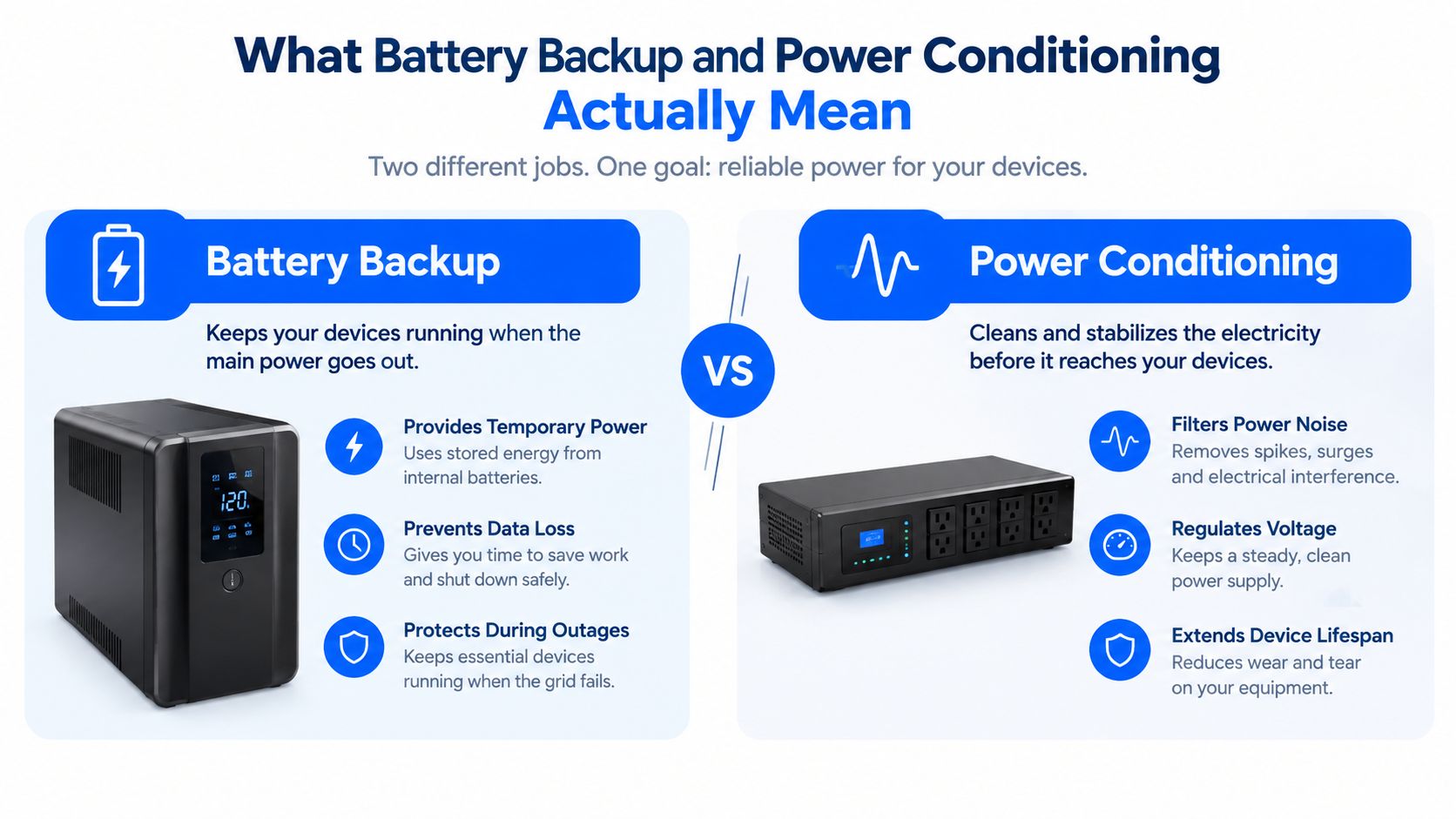
For a homeowner comparing options, this battery backup and power outage guide can help frame the outage problem separately from the power-quality problem. That separation prevents an expensive mis-purchase.
Practical rule: If the utility is still present but unstable, start with power quality. If the utility is gone, start with stored energy and load priorities.
How Online Double-Conversion Technology Works
The most complete battery backup power conditioner architecture is online double conversion. Instead of passing utility power straight to the connected equipment and waiting for a failure, the system converts incoming AC power to DC and then recreates AC power through its inverter.
The inverter continuously supplies the load. When utility power fails, the system doesn't need to switch the load from a utility path to an inverter path, so it eliminates transfer time. That matters for equipment that can reboot, drop a connection, or lose a control state during even a very brief interruption.
What the architecture corrects
Online double-conversion systems are designed to regulate a broad set of electrical disturbances:
Outages and sags, where the incoming supply falls or disappears.
Surges, brownouts, and overvoltages, which can stress power supplies and control electronics.
Line noise and switching transients, which can interfere with sensitive equipment.
Frequency variation and harmonic distortion, which can affect loads that require tightly controlled power.
This makes the design well suited to sensitive IT equipment, medical electronics, industrial controls, and systems that can't tolerate a visible interruption. A less demanding home office may not need that architecture, especially if its equipment can tolerate a short transfer and the installation prioritizes cost and simplicity.
Match the topology to the load
The global UPS category has become a multibillion-dollar industry. One market estimate places it at USD 13 billion in 2025, with a projection of USD 14.5 billion in 2026 and USD 26.8 billion by 2035, implying a 7.1% CAGR from 2026 through 2035. The same market context connects UPS demand to data centers, telecommunications, healthcare, and home and small-business resilience. Global UPS market estimates provide that broader perspective.
That growth doesn't mean every home needs a premium online unit. It means the technology has a defined role. For a Pennsylvania residence, choose it when the protected load includes equipment that must never see a transfer event, then have an electrician confirm heat, ventilation, circuit design, battery maintenance, and the available capacity.
Choosing Between Standalone Conditioners and Combined Systems
The right system starts with the failure mode, not the product label. A standalone conditioner, standalone battery backup, and combined system can each be sensible, but they solve different parts of the problem.
System type | Primary job | What it doesn't solve |
|---|---|---|
Standalone conditioner | Regulates or filters utility power | It doesn't provide outage runtime |
Standalone battery backup | Supplies stored power during an interruption | It may not provide comprehensive conditioning |
Combined system | Addresses power quality and outage continuity | It usually costs more and requires more involved planning |
A standalone conditioner fits a home office, audio rack, control system, or other sensitive load that sees voltage variation or electrical noise but doesn't need to operate through a prolonged outage. It can be the cleanest answer when the utility remains available and equipment protection is the priority.
A standalone battery backup fits equipment that needs ride-through, graceful shutdown, or short-term continuity. The important question is whether the unit regulates incoming power sufficiently for the connected load. Don't treat the word “UPS” as proof that the device offers the same conditioning performance as an online double-conversion system.
When combining both makes sense
A combined system becomes more useful when the home experiences both unstable utility power and complete outages. That might include electronics that flicker during marginal service, along with refrigerators, networking equipment, heating controls, or selected lighting that must stay online when the grid fails.
The trade-off is complexity. A combined installation may require circuit mapping, equipment coordination, ventilation planning, transfer controls, and more careful maintenance. Homeowners considering a broader home energy storage system should ask which circuits receive conditioning, which circuits receive battery support, and how the system behaves when the battery reaches its reserve limit.
Real Benefits of Protecting Your Home With Backup and Conditioning
Power quality protection matters because modern homes contain more sensitive electronics than a breaker panel alone can distinguish. A refrigerator controller, home network, furnace board, security system, and smart-home hub can all respond poorly to unstable power even when the service never fully fails.
Conditioning helps reduce the stress associated with voltage irregularities, surges, noise, and other disturbances. Battery support addresses a different consequence, loss of operation. Together, they can keep selected systems running, reduce disruptive resets, and give occupants more control over what happens during an outage.
The value shows up in ordinary routines
A properly planned installation can support practical priorities such as:
Home connectivity: Networking equipment can remain available long enough to preserve communications or allow an orderly shutdown.
Heating controls: A battery-backed furnace control circuit may be more useful than powering every receptacle.
Food storage: Keeping refrigeration operating can matter more than maintaining entertainment loads.
Work equipment: A home office can avoid abrupt computer shutdowns and lost work.
Sensitive electronics: Conditioning can address poor-quality utility power when the grid is still energized.
That last point is where many installations go wrong. A battery system that only responds after an outage doesn't necessarily correct every power-quality issue while the utility is present. Conversely, a conditioner can't provide continuity when a storm takes the service down.
For homes using integrated battery storage, intelligent load management can make the system more useful than just placing every circuit on backup. The controls can prioritize essential loads and limit discretionary demand, helping the available stored energy serve the equipment that matters most.
Pennsylvania homeowners also need to think beyond fuel and noise. Battery storage avoids the operating concerns associated with combustion equipment, while a conditioned electrical path can protect electronics during the unstable periods that often precede or follow a weather-related outage. The result is a resilience plan built around power quality, continuity, and load priorities, rather than a single device expected to do everything.
Why Bigger Batteries Are Not Always the Right Answer
A larger battery doesn't automatically produce a better installation. Storage capacity, continuous output, and surge capability answer different questions, and a system can have plenty of stored energy while still struggling with a demanding motor load.
Whole-home backup guides commonly place typical residential storage needs around 20 to 40 kWh, while essential-circuit backup can require much less. Those figures are planning guidance, not a substitute for a load calculation. Residential battery backup sizing guidance also highlights why central air conditioning presents a separate challenge, with compressor startup potentially requiring at least about 10 kW of peak output.
Calculate the loads in two dimensions
Start with the equipment you want to operate, then separate its demands:
Continuous power: How much wattage do the selected loads draw while operating?
Surge power: What happens when a compressor, pump, blower, or motor starts?
Runtime: How long should those loads remain available?
Priority: Which circuits must stay on if the system needs to conserve energy?
A refrigerator may have a modest running demand but a higher startup requirement. A furnace blower, sump pump, well pump, and air-conditioning compressor can create a combined peak that exceeds the inverter's capability even if the battery has ample kWh capacity.
Bigger storage solves runtime. It doesn't automatically solve startup surge.
Load management often beats raw capacity
Selective circuit backup can deliver a more useful result than trying to energize every appliance. A homeowner might prioritize refrigeration, heating controls, internet equipment, security, and a few lights while excluding electric resistance heat, large water heating loads, or central cooling during a constrained event.
That approach can reduce the required inverter output and storage investment. It also gives the battery a clearer job. The electrician should verify panel layout, circuit separation, transfer behavior, conductor sizing, and the available service capacity before recommending equipment.
For whole-home ambitions, ask for a written load analysis that identifies both the steady demand and the startup demand. If the proposal only lists battery capacity and doesn't address inverter output, surge rating, and controlled loads, it hasn't answered the most important sizing question.
A Southeastern Pennsylvania Homeowner Scenario
Consider a homeowner in Bucks or Montgomery County after a winter ice event. The utility has failed, the refrigerator needs to keep running, and the furnace blower and controls are important for comfort. But during earlier storms, the same homeowner also noticed lights flickering and electronics restarting before the outage began.
A battery-only answer may cover the blackout but leave the power-quality problem unaddressed. A conditioner-only answer may smooth the flicker but do nothing once the service is lost. A combined design can separate those events, conditioning selected sensitive circuits during unstable utility operation and supplying prioritized circuits from stored energy during an outage.
The design still needs boundaries. The homeowner may not need to run central air conditioning, electric heat, laundry equipment, and every receptacle simultaneously. A contractor can identify the essential circuits, check motor startup requirements, and create a control strategy that preserves the refrigerator, heating system, communications, and safety equipment first.
This scenario also explains why a small UPS isn't automatically a whole-home solution. It may protect a network cabinet or workstation, but it usually lacks the output, transfer equipment, and distribution arrangement needed for major household circuits. Whole-home resilience requires electrical planning, not just plugging more devices into a larger battery.
Taking the Next Step Toward Whole-Home Power Resilience
Begin with an inventory of the loads you care about during an outage. Separate equipment that needs clean utility power from equipment that needs stored power, then note which motors, compressors, pumps, and heating systems create startup surges.
Ask for an assessment, not a guess
A professional site assessment should review:
Panel and service capacity: The existing electrical infrastructure may need an upgrade before it can support new storage or transfer equipment.
Critical circuits: The installer should identify which loads belong on backup and how they will be isolated or managed.
Power quality needs: Sensitive electronics may need conditioning even when they aren't part of the primary outage plan.
Runtime expectations: The desired duration depends on the selected loads and their operating pattern.
Surge requirements: Motor startup can determine inverter selection more than the battery's stored-energy rating.
Code and installation conditions: Equipment location, clearances, wiring, disconnects, and local requirements all affect the final design.
For systems connected to a home's electrical distribution, transfer equipment deserves careful attention. An automatic transfer switch explanation can help clarify how a backup source is separated from utility power and how the system changes sources safely.
Choose architecture before capacity
If your priority is protection from flicker, noise, and voltage variation, start with conditioning. If your priority is outage ride-through, start with battery output, runtime, and circuit selection. If you experience both conditions, evaluate a combined system, but insist on a clear description of which functions each component performs.
Amp'd Energy Solutions designs and installs battery backup systems, Tesla Powerwall systems, whole-house generators, and electrical service upgrades for homes and businesses in Southeastern Pennsylvania. The company can assess your panel, critical loads, surge requirements, and installation options before you commit to a capacity that may not match your actual needs.
If you're planning backup power or want to protect sensitive home equipment from unstable utility service, contact Amp'd Energy Solutions for a site assessment in Southeastern Pennsylvania. Ask for load and surge analysis, a critical-circuit plan, and a clear explanation of how the proposed system will condition power and handle a real outage.
Comments