

Automatic Transfer Switch Home Generator
A storm rolls in, the kitchen lights flicker, and the refrigerator pauses before starting again. You hear the wind pushing branches against the service line and wonder whether your standby generator will start by itself, or whether you'll be searching for a flashlight and a breaker panel in the dark.
An automatic transfer switch, or ATS, controls that handoff. It watches the utility supply, tells a compatible generator to start when the grid becomes unacceptable, moves the home's electrical load to generator power, and returns the load to the utility when service is stable again. The process is automatic, but it isn't instantaneous, and a brief interruption is normal.
In the United States, prolonged outages affect a substantial number of households. An independent 2026 summary of Energy Information Administration data estimates that 28.72 million of 132.54 million occupied primary residences experienced an outage lasting at least 24 hours in 2024, while 6.61 million homes had a whole-home or standby generator and 20.26 million had a portable generator. You can review the underlying market summary at State of Home Backup Power 2026. That scale helps explain why an ATS-equipped home generator is a practical system category, not a novelty.
Table of Contents
What Happens When the Power Goes Out - The first decision belongs to the ATS - Expect a short dark window
How an Automatic Transfer Switch Actually Works - Sensing comes before starting - The switch and generator form one system
Sizing the Transfer Switch to Your Home - Match the switch to the service - Account for starting demand
What a Real Outage Feels Like With an ATS - The transfer is deliberate - Return power also has a sequence
Compatibility and Installation Considerations - Communication and ratings come first - Location and inspection matter
What Happens When the Power Goes Out
A storm can leave the kitchen lights flickering while the refrigerator keeps trying to run. The ATS does not treat every flicker as a full outage. It follows a decision sequence, separating a brief disturbance from a condition that requires generator power.
The first decision belongs to the ATS
An ATS continuously checks the utility source. During a hard outage, it detects that voltage has disappeared. During a brownout, voltage may remain present but fall below the programmed acceptable range. Depending on the equipment, the controller also considers frequency and whether the condition lasts long enough to justify action.
Its sequence has three jobs:
Sense the disturbance. The ATS checks whether utility voltage and frequency remain within their configured limits.
Start and transfer. It signals the compatible standby generator, waits for suitable operating conditions, then moves the home's load.
Return safely. It confirms that utility power has stabilized before reconnecting the home and allowing the generator to stop.
A standby generator with an automatic switch can complete this process without manual intervention, often in about 10 seconds, according to this overview of automatic transfer switch operation. The actual delay depends on the generator, controller settings, source quality, and whether the event is a momentary blink, a brownout, or a sustained failure.

Expect a short dark window
Most residential systems use open-transition transfer. The ATS disconnects the utility before connecting the generator, preventing both sources from being connected together. That break-before-make action creates a short power gap. Lights can go out, clocks may reset, and electronics may reboot.
Practical expectation: Automatic backup power does not guarantee an invisible transition for every device in the house.
Once the generator carries the load, the ATS continues monitoring the utility. When grid power returns, it does not reconnect at the first hint of voltage. The controller waits for stable conditions, transfers the load back, and lets the generator cool down before shutting it off.
The generator produces electricity. The ATS controls when that electricity can serve the home, which is why the switch's timing and settings shape the outage experience.
How an Automatic Transfer Switch Actually Works
Think of the ATS as a relay system with a quality check. A thermostat doesn't turn on heating equipment every time room temperature moves by a tiny amount. It compares the measured condition with a control range. An ATS does something similar with utility voltage and, depending on the equipment, frequency and generator-side voltage.
Sensing comes before starting
While utility power is available, the controller observes the incoming source. A brief dip may not satisfy the programmed outage condition. A sustained undervoltage, loss of voltage, or unacceptable frequency condition can start the transfer sequence.
The exact sequence commonly includes:
Detection: The controller identifies a utility condition outside its acceptable range.
Start signal: The ATS sends a dedicated control signal to the generator controller.
Crank and warm-up: The generator starts and stabilizes before accepting the home's load.
Transfer: A contactor moves the load from the utility conductors to the generator conductors.
Retransfer: After utility power remains stable, the contactor returns the load to the grid.
This is control logic, not a single instantaneous mechanical movement. The manufacturer explanation of transfer-switch troubleshooting describes how generator voltage, transfer-circuit voltage, line-interrupt delay, warm-up timing, and return-to-utility logic all influence the event. A brownout can therefore produce a different response from a complete blackout, especially if voltage fluctuates around the programmed threshold.
The switch and generator form one system
The ATS and generator controller must communicate correctly. Many residential systems use a dedicated two-wire start circuit. The ATS doesn't independently operate the engine, regulate fuel, or decide whether the generator has reached its operating voltage. It requests a start, while the generator controller manages cranking, engine operation, stabilization, alarms, and shutdown.
Load-management equipment adds another layer. If demand exceeds what the generator can support, the system can signal managed circuits to disconnect temporarily. That might mean delaying or shedding a high-demand appliance while preserving selected critical loads.
An open-transition ATS creates a brief gap because it opens the utility connection before closing the generator connection. A closed-transition unit can overlap the sources under controlled conditions, but its suitability depends on equipment design, utility requirements, and the installation. Don't assume a closed transition is automatically appropriate for a residence.
A reliable ATS doesn't react to every flicker. It applies programmed conditions so the generator won't start and stop unnecessarily during unstable utility service.
Whole-House vs Essential-Circuit Transfer Switches
The right configuration depends on what you want powered, how the home's panel is arranged, and how much generator capacity you plan to install. There isn't one universally correct ATS arrangement.
A whole-house ATS typically sits at the main service and is matched to the home's service rating. It can transfer the entire panel, which gives the generator access to heating and cooling equipment, refrigeration, lighting, communications, and other circuits. That doesn't mean every appliance can run simultaneously. The generator still has a finite output, and high-startup loads can compete with one another.
An essential-circuit ATS serves a selected group of circuits, often through a critical-loads subpanel. Homeowners may choose refrigeration, heating controls, a sump pump, a well pump, selected lighting, security equipment, and internet equipment while leaving large discretionary loads on utility-only circuits. This arrangement can reduce generator demand and may suit a smaller system.
Criterion | Whole-House ATS | Essential-Circuit ATS |
|---|---|---|
Coverage | Transfers the main home's circuits | Transfers only selected circuits |
Generator demand | Can be high when multiple loads operate together | Easier to limit to priority loads |
Air conditioning | May be included if generator capacity supports it | Included only if specifically routed and supported |
Panel arrangement | Usually coordinated with the main service | Uses a critical-loads panel or selected circuit arrangement |
Future changes | Leaves more circuits available for later planning | Requires review when adding new priority loads |
Best fit | Homeowners seeking broad continuity | Homeowners prioritizing defined loads and controlled demand |
Service rating, fuel planning, future electrical additions, and panel space all deserve attention before selecting equipment. A home that may later add an electric range, vehicle charger, or other high-demand load needs a different conversation from a home focused on refrigeration, heating, and water management.
The whole-house generator transfer-switch guide can help homeowners understand how the generator, service equipment, and transfer arrangement fit together. Use it as preparation for an electrical assessment, not as a substitute for a site-specific design.
Sizing the Transfer Switch to Your Home
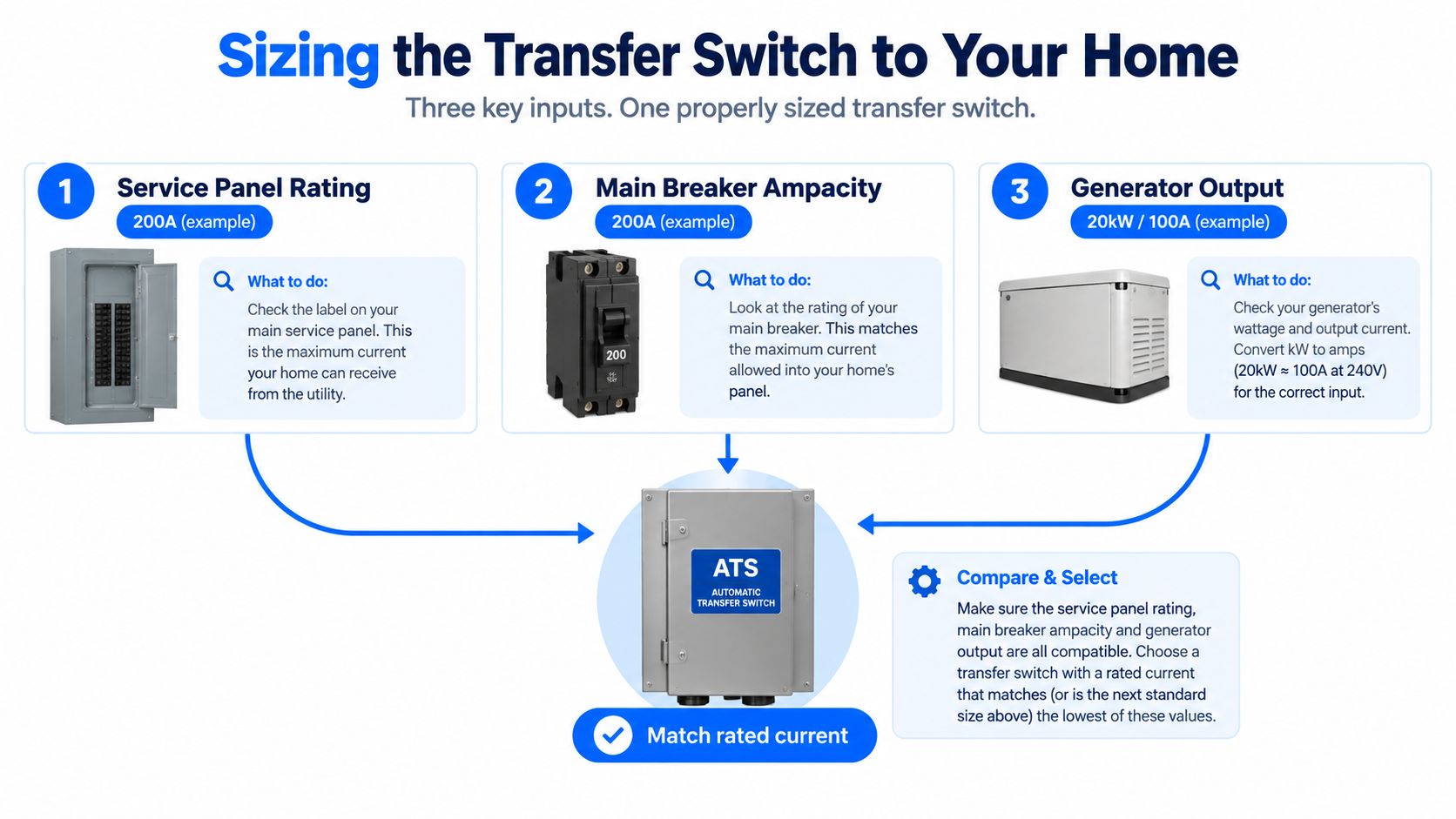
A home with a 200-amp service, a 200-amp main breaker, and an air-cooled standby generator in the 16 to 22 kW range may use a 200-amp service-rated ATS for a whole-service installation. The generator produces far less current than the service rating, yet the switch still must safely carry the home's service conductors.
That distinction is central to ATS sizing. The switch's ampacity describes the current its components and conductors can carry safely. It does not promise that the generator can supply that amount continuously. Generator output and the loads operating at the same time determine what the backup system can support.
Match the switch to the service
The installer reviews the service-panel rating, main-breaker ampacity, transfer-switch rating, generator output, and expected load combinations. A 100-amp essential-circuit ATS is not a direct replacement for a 200-amp whole-service switch. It may suit a critical-loads subpanel, but it transfers only that defined portion of the installation.
Use the whole-house generator sizing calculator to organize household loads before the site visit. The result is a planning aid. The installer still needs to verify the panel configuration, conductors, disconnects, and local requirements.
Account for starting demand
Air-conditioning compressors, pumps, and refrigeration equipment can draw more current while starting than while running. Several motor loads starting together can create a short demand spike, even when their normal operating load appears manageable.
Load-management modules can help by temporarily disconnecting selected equipment as generator demand rises. The ATS then works as part of a coordinated control system, rather than acting as an isolated switch. The installer should confirm that the transfer equipment, generator controls, and load-management method are compatible with the appliances you expect to operate.
Bring these questions to the site visit:
Service capacity: What are the panel rating and main-breaker ampacity?
Priority loads: Which appliances need to operate at the same time?
Motor starts: Which pumps, compressors, or fans create starting demand?
Future additions: Could an EV charger, electric heat, solar, or another major load be added?
Transfer arrangement: Will the system serve the whole service or a critical-loads subpanel?
A practical guide to residential transfer switch sizing from Ferguson Home reinforces the rule that transfer-switch ampacity should align with the home's service or main breaker. Load-management equipment can then help keep actual demand within the generator's capacity.
What a Real Outage Feels Like With an ATS
A real outage often starts with a flicker. Utility voltage may dip, recover briefly, and then vanish. The ATS watches that change instead of reacting to every brief disturbance. Its first decision is whether the utility has failed long enough to justify starting the generator.
Once the controller confirms the outage, it sends a start signal. The generator cranks, builds suitable voltage and frequency, and completes its warm-up sequence. During this interval, much of the house can remain without power. That pause is normal, not evidence that the ATS has failed.
The transfer is deliberate
When the generator is ready, the ATS opens the utility connection before closing the generator connection. This open-transition sequence keeps the two sources isolated. Lights may flicker again, and clocks or electronic equipment may restart as the load accepts generator power.
The complete response is commonly described as taking about 10 seconds, but the homeowner's experience depends on several programmed steps. The ATS must recognize a sustained problem, the generator must start and stabilize, and the equipment must finish its transfer delay. An automatic transfer switch operation overview describes the process, but the installed system determines the actual timing. Expect automatic operation with a short interruption, not instant backup.
Once generator power carries the home, the ATS keeps checking both sources. If demand rises beyond what the generator can support, load-management controls may disconnect selected circuits. A comfort load could pause while priority circuits continue operating and the system avoids an overload.
Return power also has a sequence
Utility power returning does not always mean an immediate transfer. The ATS checks that the source remains stable because a storm-damaged grid can fluctuate during restoration. Waiting prevents the home from switching repeatedly between sources.
After the return timer is satisfied, the ATS reconnects the home to utility power. The generator then runs through its cooldown period before shutting down and returning to standby. From indoors, you may notice lights change source, a pump or compressor restart, and the generator's sound fade.
Good control logic is quiet. The system waits when the utility is uncertain, transfers only when a source is suitable, and keeps both sources isolated.
Compatibility and Installation Considerations
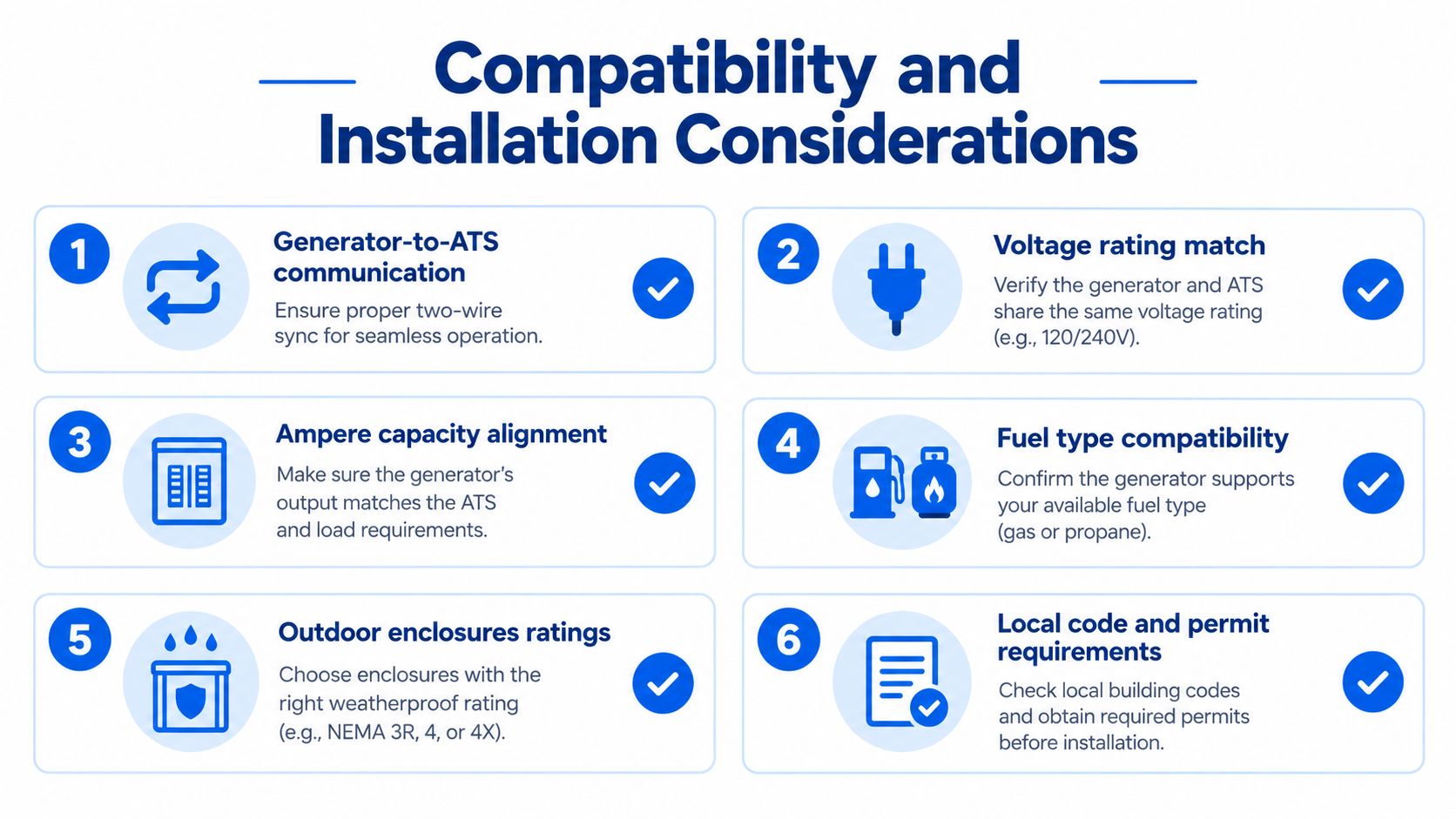
An ATS must match the generator's control system, electrical ratings, physical location, and local installation requirements. A switch that looks suitable on paper may still be wrong if its controller cannot interpret the generator's start, ready, fault, or load-management signals.
Communication and ratings come first
The installer should verify the generator-to-ATS communication method, including the dedicated start circuit and any control wiring required for warm-up, transfer, retransfer, and cooldown. The generator controller and ATS need compatible logic so a start request produces the intended response and a fault doesn't leave the system in an unsafe state.
Electrical compatibility includes:
Voltage: The generator and transfer equipment must use compatible voltage and phase arrangements.
Ampacity: The ATS and conductors must suit the service or the selected critical-loads configuration.
Fuel: The generator must be configured for the available fuel supply and site conditions.
Enclosure: Outdoor equipment needs an enclosure appropriate for its installation environment.
Grounding: Grounding and bonding must follow the equipment design and applicable code.
Protection: Disconnects and overcurrent protection must be coordinated with the system.
Location and inspection matter
Installers commonly place the ATS near the main service panel, in an appropriate utility area, or in a weather-resistant outdoor enclosure. The location must provide required working space, protect the equipment from damage, and allow service access. The generator-side disconnect and service equipment arrangement also need to fit the site's wiring and utility requirements.
Permitting and inspection requirements vary by jurisdiction. A property with solar or other generation equipment may need an especially careful review of service isolation, disconnect placement, and utility rules. The automatic transfer switch installation guide offers useful preparation points, but the electrician must apply local requirements to the actual property.
Before commissioning, a qualified electrician should verify conductor sizing, lug torque, grounding and bonding, control wiring, equipment labels, and the complete transfer sequence. The final test should simulate a utility outage and confirm generator start, warm-up, load transfer, return transfer, cooldown, and fault behavior.
Common Misconceptions About Home Generator ATS Units
A larger generator removes the need for load management. It may provide more capacity, but motors still have starting demand and households can run several large appliances at once. The ATS and generator must be coordinated so demand stays within the available output.
The transfer is instantaneous. An ATS transfers automatically, but the generator needs time to receive the start request, crank, stabilize, and become ready. Open-transition equipment also creates a brief gap while the utility source disconnects and the generator source connects.
Any transfer switch works with any generator. The control protocol, voltage arrangement, ratings, and load-management signals must match. A switch isn't a universal accessory that can be paired safely with an unrelated generator without verification.
The ATS replaces proper electrical design. It prevents the home from being connected to utility and generator power at the same time, but it can't correct an undersized service, poor conductor selection, inadequate grounding, or a generator that can't support the intended loads. The ATS safety explanation from the equipment manufacturer describes the switch's role in monitoring sources and controlling the transfer.
A homeowner can install it as a simple DIY project. The equipment may look like a box with a switch, but it can involve service conductors, generator controls, grounding, bonding, disconnects, permits, and inspection. A mistake can create shock, fire, equipment-damage, or backfeed hazards.
The useful mental model is a coordination device. The ATS makes source selection safe and automatic, but it doesn't create generator capacity or remove the need for a properly designed installation.
Choosing the Right ATS Setup for Your Home
When lights flicker, the right ATS setup depends on what you expect it to do next. During a brownout, the switch may wait while it confirms whether utility power is stable. During a hard outage, it detects the failed source, signals the generator, and transfers power only after the generator is ready. Your chosen coverage determines which circuits enter that sequence.
Decide whether you want whole-home coverage, selected priority circuits, or managed coverage that changes as generator demand rises. Then review these points with the installer:
Coverage: Which circuits must stay available during a prolonged outage?
Service rating: What are the panel rating and main-breaker ampacity?
Compatibility: Can the generator controller communicate with the proposed ATS?
Site requirements: Which permits, disconnects, inspections, and utility conditions apply?
Include future plans. An EV charger, electric heating, solar system, battery storage, or service upgrade can change the load calculation and transfer arrangement.
For homeowners in Southeastern Pennsylvania, Amp'd Energy Solutions evaluates generator projects, transfer equipment, panel work, and service upgrades through its electrical and backup-power team.
Document your priority loads, confirm the panel rating, and schedule a site assessment before ordering equipment.
Comments