

Whole House Generator Backup How It Keeps Power On
A lot of homeowners start thinking about backup power the same way. The storm passes, the lights don't come back, the refrigerator starts warming, the Wi-Fi dies, and the house gets strangely quiet when the HVAC stops. In Southeastern Pennsylvania, that moment often turns a vague “maybe someday” project into a very practical question.
That's why whole house generator backup isn't just a luxury conversation anymore. U.S. electricity customers experienced an average of 11 hours without power in 2024, the highest level in more than a decade, and power outages are estimated to cost the U.S. economy about $150 billion each year according to standby generator outage and adoption statistics. When outages last longer and happen more often, homeowners stop thinking only about convenience and start thinking about continuity.
The confusing part is that most advice still starts with square footage. That's rarely the best place to start. A smarter conversation begins with what you need to run, how long outages tend to last, what fuel you can supply, and whether a generator-only or hybrid generator-plus-battery setup fits your house better.
Table of Contents
When the Lights Go Out and Stay Out - Why the old sizing question misses the real problem - The kitchen-table version of backup planning
How Whole House Generator Backup Really Works - Think of the ATS like a traffic officer - What “whole house” really means - Standby isn't the same as portable
Inside the Automatic Transfer Switch Sequence - What happens first - Where the switch sits matters - Why this sequence is safer than manual improvising
Generator Battery and Hybrid Backup Compared - Match the system to the outage pattern - Choosing Between Generator Battery and Hybrid Backup - A practical way to think about it
Sizing Your System for Real Loads and Real Outages - Start with the load list - ATS size and generator size are not the same thing - Fuel logistics decide whether the plan holds up - The sizing mistakes I see most often
Benefits Costs and What Ownership Feels Like - What you gain, and what you live with - Cost is really three costs
Planning Your Whole House Backup With Confidence - A clean decision path
When the Lights Go Out and Stay Out
At 7 p.m., a power outage feels manageable. By midnight, the house starts showing you what electricity was doing in the background the whole time.
The refrigerator is coasting for now. The sump pump may not be. If your home uses a well pump, water service can disappear with the lights. In winter, indoor temperature starts drifting. In summer, humidity builds fast. A home office goes dark, routers shut down, garage doors stop, and a quiet house suddenly becomes a list of systems that are no longer working.
That shift matters. Backup power decisions usually do not start with equipment. They start with a homeowner realizing that an outage is not one problem. It is a chain of smaller problems with different deadlines. Some loads can wait for hours. Some need power in minutes. A few cannot go down at all.
Why the old sizing question misses the real problem
The first question many homeowners ask is, “What size generator do I need?”
A licensed electrician hears a different question underneath it. “What am I trying to protect, for how long, and with what fuel?”
That is a better place to begin because outage planning works more like packing for a trip than buying a bigger appliance. If you are planning for a 20-minute interruption, a battery may cover the gap. If your neighborhood tends to lose power overnight or for multiple days after a storm, fuel supply becomes part of the design, not an afterthought. Natural gas, propane, and battery storage each change the plan in different ways.
The kitchen-table version of backup planning
Square footage can help estimate the size of HVAC equipment, but it does a poor job of describing what must stay powered during an outage. Two houses with the same floor area can have completely different backup needs.
A more useful checklist looks like this:
Loads that must stay on first: refrigeration, sump pump, well pump, medical equipment, a few lights, internet, and selected outlets
Loads that matter if the outage stretches: heating or air conditioning, water heater, cooking, laundry, and garage doors
Outage length you are preparing for: brief utility blips, overnight outages, or multi-day events
Fuel you can realistically count on: natural gas service, propane storage on site, or battery runtime before a generator needs to take over
How you want the house to behave: fully automatic whole-home coverage, selected circuits only, or a hybrid setup that keeps short outages quiet and uses the generator for long ones
That last point trips people up.
Many homeowners picture backup power as a single machine outside the house. In practice, the better question is how the house decides what source to use and when. In a generator-only setup, the generator carries the load after an outage. In a hybrid setup, batteries can handle the short interruptions and the generator can step in for longer runs, heavy motor loads, or fuel-efficient recharging support. The decision point between those sources matters as much as the generator itself.
Whole-house backup is less about matching a generator to square footage and more about matching your loads, outage duration, and fuel plan to the way your home actually lives.
How Whole House Generator Backup Really Works
A standby backup system has three main jobs. First, it watches the utility power coming into your home. Second, it makes electricity when the utility fails. Third, it switches your house from one source to the other safely.
If you strip away the jargon, the system has three core parts:
Utility service brings normal grid power to the house.
Standby generator sits outside, ready to start automatically.
Automatic transfer switch, often called the ATS, decides which source is allowed to feed the home.
Think of the ATS like a traffic officer
Power can't come from the utility and the generator into the same service path at the same time. That would be dangerous for your equipment and for lineworkers restoring utility service. So the ATS acts like a traffic officer at an intersection. It stops one direction before allowing the other to move.
Key idea: The automatic transfer switch is the decision hub. The generator makes power, but the ATS decides when the house may use it.
Homeowners often get tripped up. They assume the generator is the star of the system. In practice, the ATS is what makes the system safe, automatic, and code-compliant.
What “whole house” really means
“Whole house” can mean two different things in real installations.
One version is full-service backup, where the system is arranged so the entire home can be fed, often with some load management to prevent overload. The other is essential-load backup, where only selected circuits are carried during an outage. Both can use an automatic transfer switch. The difference is how much of the home is connected and how carefully loads are managed.
That's one reason generic shopping advice falls short. A smaller generator can still support a very capable home backup plan if the electrician and homeowner choose loads carefully.
Standby isn't the same as portable
A portable generator is a manually operated emergency tool. A standby generator is a permanently installed system tied into the home's electrical and fuel systems. It starts automatically when utility power drops out.
Fuel matters too. Some homes rely on a natural gas line. Others use propane storage. Either way, runtime planning matters more than label-reading. If the outage lasts longer than your fuel plan, the generator stops being a whole-home solution and becomes a short-window solution.
If you want to see how a professionally integrated home system is typically framed, whole-home generator options are usually presented around transfer equipment, fuel source, and managed loads rather than just generator nameplate size.
Inside the Automatic Transfer Switch Sequence
The switchover feels almost invisible when it works correctly. That's the point. But several things happen in order, and each step matters.
What happens first
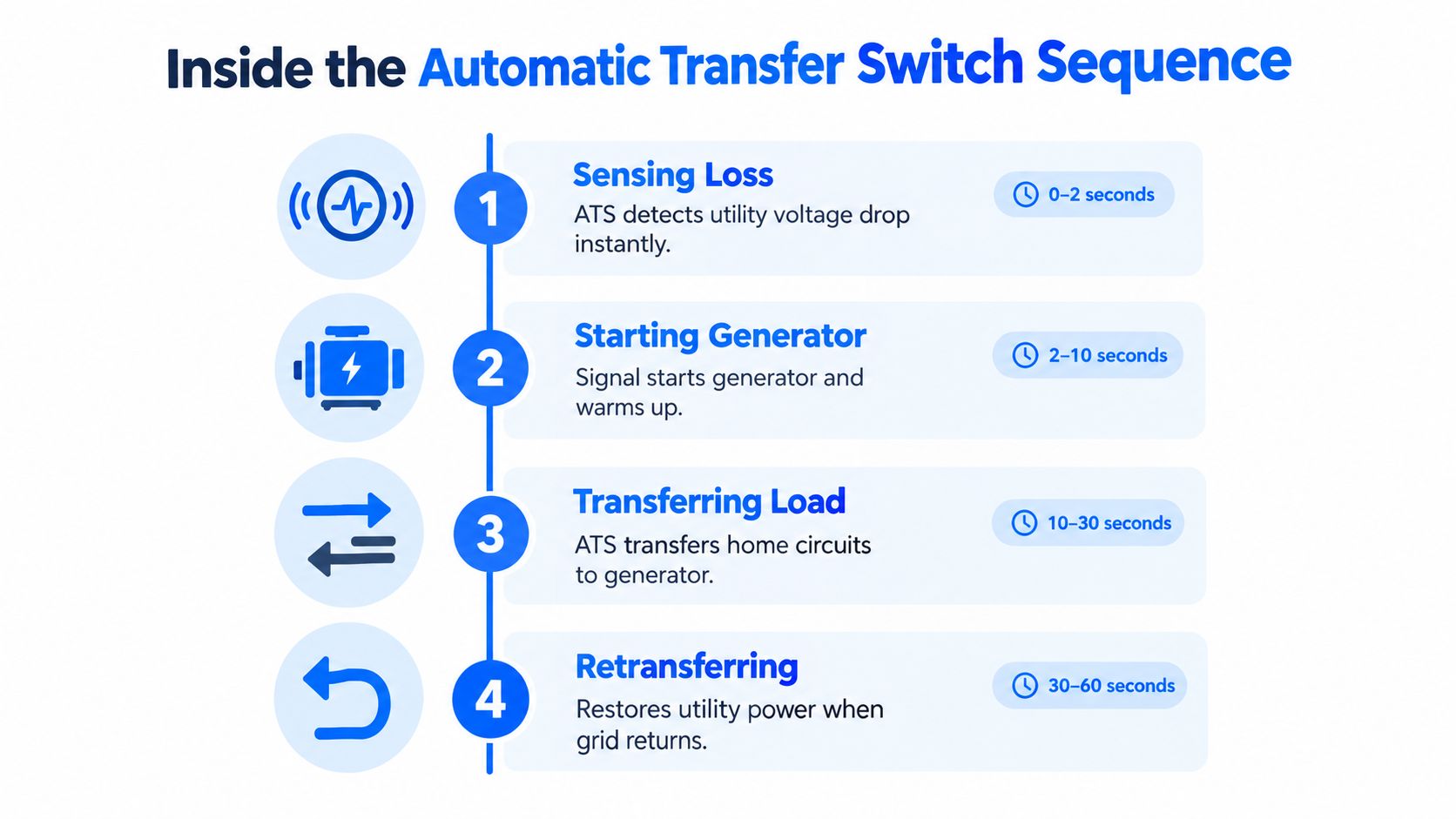
The ATS continuously monitors incoming utility voltage. If the utility drops out or falls below acceptable levels, the switch doesn't instantly throw everything over in a reckless way. It follows a controlled sequence.
It senses loss of utility power.
It sends a start signal to the generator.
It waits for generator output to stabilize.
It transfers the home load to generator power.
When utility power returns and remains stable, the sequence happens in reverse. The ATS transfers the load back to utility power and the generator shuts down after its cooldown routine.
Where the switch sits matters
Some homes use a service-entrance transfer switch near the main service equipment. Others use a transfer arrangement tied to a subpanel that carries selected outage circuits. The right layout depends on how the home is wired and whether the goal is whole-home coverage or only certain loads.
Here's the practical rule homeowners should remember. The transfer switch is commonly sized to match the home's main service disconnect or main breaker because it must safely carry utility-side current through the service path, even if the generator itself is smaller. A 200 A residential main generally implies a 200 A-rated automatic transfer switch, according to automatic transfer switch sizing guidance for main breaker and generator coordination.
That surprises people. They'll ask, “If my generator is smaller, why does the switch need to match the main?” Because the switch is part of the utility service path. It has to safely carry what the service can deliver, not just what the generator can produce.
Why this sequence is safer than manual improvising
Improvised backup setups tend to fail in one of two ways. Either they don't transfer load cleanly, or they create a risk of backfeeding the utility. The ATS solves both problems by enforcing separation between power sources.
The transfer switch must think about the house as a service system, not just as a pile of appliances.
That's why a proper standby installation feels calm during an outage. The equipment handles the transition in a defined order, with sensing, delay, interlocks, and retransfer built into the design.
Generator Battery and Hybrid Backup Compared
A generator and a battery don't solve the same problem. That's the heart of the decision.
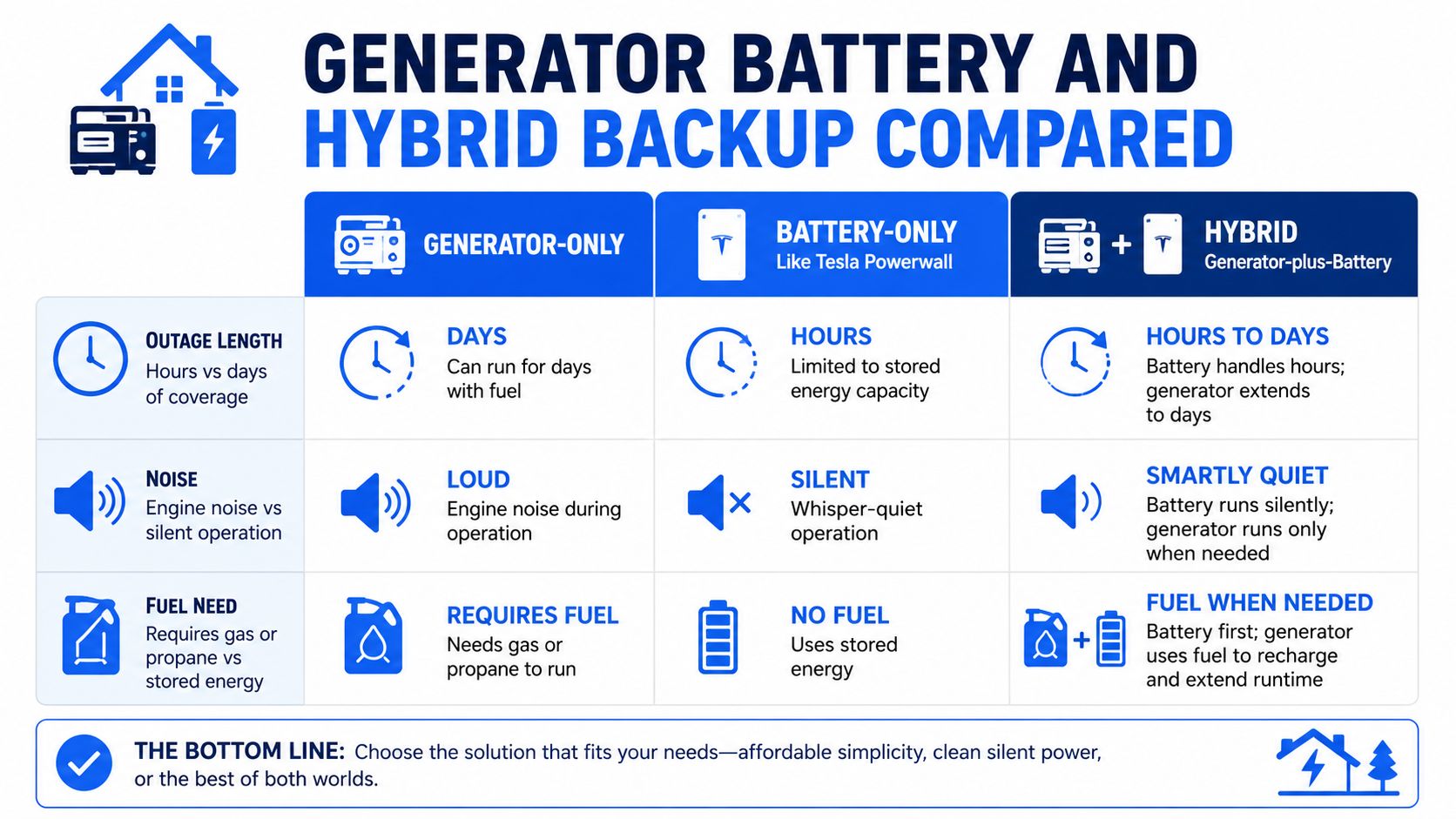
A battery is excellent for short interruptions, silent operation, and instant continuity for things like lighting, electronics, and internet gear. A generator is better at carrying a home through a long outage, especially when fuel can be replenished. A hybrid system combines those strengths.
Match the system to the outage pattern
Recent guidance has increasingly framed backup planning around this split. Batteries handle brief interruptions, while generators are better suited to multi-day outages when fuel can be replenished. The same reporting also highlights IoT-enabled monitoring, AI-powered energy management, and automated switching as emerging trends in 2026, which matters because hybrid systems rely on smarter coordination between stored energy, generator runtime, and load behavior, as noted in home generator market coverage focused on hybrid backup trends.
That's a long way from the old “generator or no generator” conversation.
Choosing Between Generator Battery and Hybrid Backup
System Type | Best For | Limitation to Consider |
|---|---|---|
Generator-only | Homes that need HVAC, refrigeration, pumps, and broad coverage through longer outages | Fuel supply, maintenance, and engine noise matter |
Battery-only | Short outages, quiet operation, and seamless support for selected loads | Long outages can outlast stored energy |
Hybrid | Homes that want silent short-term backup plus sustained power during long outages | Planning and integration are more complex |
A practical way to think about it
If your outages are usually brief and your priority is keeping the house from blinking off, a battery can feel elegant. If your concern is a storm outage that lingers, a generator is the more durable tool. If you want both, hybrid planning becomes very attractive.
Consider a simple household example:
Short outage household: Work-from-home couple, modem, lights, refrigerator, and no desire to hear an engine every time the grid flickers.
Long outage household: Family with central HVAC, sump pump, refrigeration, and concern about a storm outage that stretches overnight or longer.
Mixed-pattern household: Wants silent instant ride-through for everyday interruptions but also wants fuel-backed endurance if the outage becomes serious.
For homeowners exploring storage as part of that mix, battery backup solutions for outage protection are usually worth evaluating alongside generator planning rather than after it. The systems affect each other. Panel space, transfer equipment, circuit priorities, and monitoring all need to work together.
Practical rule: If you already know you hate noise, worry about fuel logistics, and still need protection against long outages, don't force a binary choice. Look at hybrid backup first.
Sizing Your System for Real Loads and Real Outages
Square footage is a shortcut. It's convenient, but it doesn't tell you what turns on during an outage.
A small house with electric heat, a deep well pump, and two large cooling loads can stress a backup system far more than a larger house with gas heat and carefully selected essential circuits. That's why good sizing starts with electrical behavior, not real estate.
Start with the load list
Neutral sizing guidance emphasizes calculating the true electrical load, confirming natural gas pressure or propane tank capacity, and accounting for worst-case runtime instead of relying on marketing shortcuts. That matters more now because U.S. customers averaged 11 outage hours in 2024, weather caused 83% of outages, and major weather events lasted nearly 9 hours on average, according to whole-house backup generator sizing and outage planning guidance.
Here's the checklist I'd want a homeowner to build before any site visit:
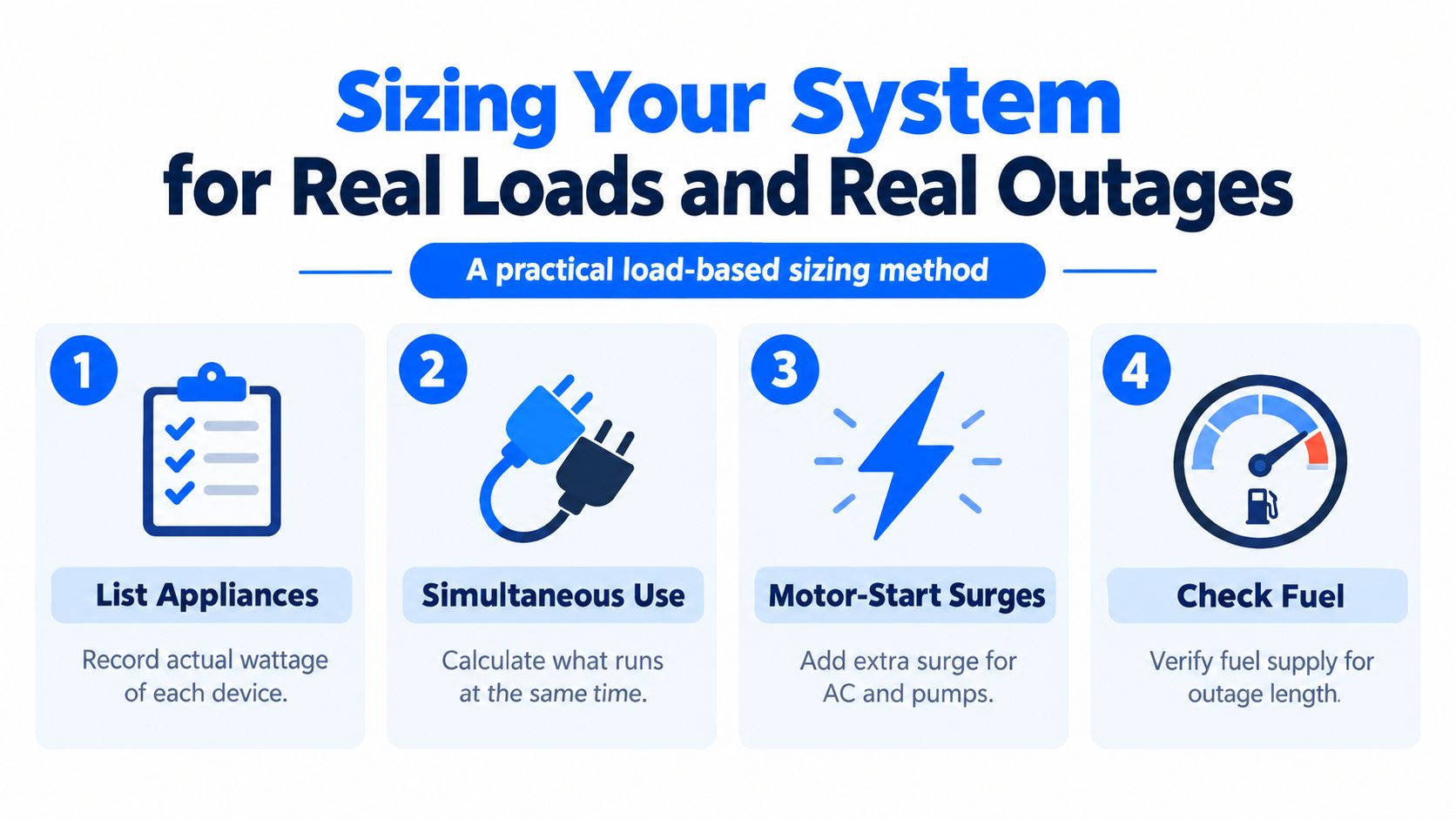
List actual appliances: HVAC equipment, refrigeration, well or sump pumps, water heating, cooking loads, internet equipment, medical devices, and lighting.
Mark what must run together: Air conditioning and well pump at the same time is a different design problem than “either one, but not both.”
Flag motor loads: Compressors and pumps have startup surges that can be much higher than their normal running draw.
Check fuel reality: A generator that can theoretically run the house still needs enough gas supply or propane capacity for the outage you're preparing for.
ATS size and generator size are not the same thing
This is one of the most important distinctions in a whole house generator backup project.
The ATS rating follows the home's service path, while the generator size follows the managed outage load. Those are related, but they are not identical. A house can have a transfer switch sized to the main service and still use load management so the generator only supports selected circuits or staged loads.
Fuel logistics decide whether the plan holds up
A backup plan isn't finished when the wattage math works.
Natural gas systems need enough available pressure and flow. Propane systems need enough stored fuel for the likely runtime. If the neighborhood tends to lose power for longer periods after severe weather, you don't want a system sized only for comfort during the first few hours.
For some homes, the better answer is selective backup with smart load management. For others, the panel itself may need work before backup integration makes sense. If a house already has significant electrical additions or limited capacity, electrical service upgrades for higher-demand homes can become part of the backup conversation.
The sizing mistakes I see most often
Buying by square footage alone: Two homes with the same floor area can have very different electrical demand.
Ignoring startup surge: Air conditioners, pumps, and compressors don't start gently.
Assuming fuel is unlimited: Runtime depends on supply, not just generator capability.
Forgetting lifestyle loads: Home office equipment, aquariums, refrigerated medicine, and garage access often matter more than homeowners first realize.
A well-sized system doesn't just turn on. It keeps operating through the outage you're actually likely to have.
Benefits Costs and What Ownership Feels Like
At 2 a.m., after a storm has already been through once, ownership feels a lot different from shopping.
If the outage lasts ten minutes, almost any backup plan can feel acceptable. If it lasts two days and the roads are blocked, the question changes. Can the refrigerator stay cold, can the heat or AC keep up, can the sump pump keep cycling, and do you have a fuel plan that still works on day two? That is why the benefit is not just that power comes back. It is that the house can keep doing the jobs that matter during a long interruption.
For some households, that means preserving food and keeping internet service up for work. For others, it means avoiding a flooded basement, protecting refrigerated medication, or keeping well water available. A whole house generator is less like a convenience gadget and more like an alternate engine for the same house.
The automatic transfer switch is a big part of what ownership feels like in practice. It acts like the traffic officer for the home's power path. During an outage, it routes the house to generator power. In a hybrid setup, it can also be the decision hub that helps coordinate what the generator carries, what the battery handles first, and how the house transitions back to utility power once the grid returns.
What you gain, and what you live with
A well-planned standby system gives you:
Continuity: Lights, refrigeration, communications, pumps, and selected comfort loads can keep running with far less disruption.
Less scramble: No dragging cords, rationing outlets, or rewriting the day around a dark house.
Better support for long outages: With the right fuel strategy, backup can continue well beyond the first few hours.
A clearer path for hybrid backup: Pairing generator power with battery storage can cover short outages and stretch fuel during long ones.
Ownership also comes with ongoing responsibilities.
Maintenance: The engine, starting battery, controls, and transfer equipment need inspection and service.
Noise: Even a well-installed unit is still an outdoor engine.
Fuel discipline: Natural gas availability, propane storage, and refill reality matter more than brochure runtime.
Site and code constraints: Placement, clearances, and permitting can shape the final design as much as the load calculation.
Cost is really three costs
Homeowners usually focus on purchase price first, but ownership is easier to judge if you separate the cost into three buckets.
The first is installation. That includes the generator, transfer equipment, electrical labor, pad or mounting work, and sometimes panel or service changes.
The second is operating cost. Fuel use rises sharply when you ask the system to carry large heating, cooling, or motor loads for long periods. A hybrid plan can help here by letting batteries handle short interruptions or lighter overnight loads, while the generator covers the heavier work.
The third is readiness cost. Maintenance visits, battery replacement, and the occasional repair are part of keeping the system dependable. Backup power is a lot like a standby pump on a boat. You hope it sits for long stretches, but when you need it, you need it to start immediately.
A whole house generator feels worthwhile when it matches the outage pattern you face and the fuel supply you can realistically count on. If your outages are short and your must-run loads are small, a battery-centered or hybrid approach may fit better. If outages are longer, weather-related, or likely to threaten heating, water removal, food storage, or medical needs, generator ownership usually feels less like an upgrade and more like insurance you can hear working outside.
Planning Your Whole House Backup With Confidence
Good backup planning is less about shopping and more about decision order.
Start with the loads that matter most. Then look at outage pattern. Then fuel. Then panel readiness and transfer-switch layout. If you already have, or may later add, battery storage or EV charging, bring that into the conversation early so the electrical plan doesn't get boxed in.
A clean decision path
Use this short checklist when you're getting serious:
Know your must-run loads: Not every circuit matters equally.
Check outage reality: Plan for the outage you're likely to get, not the one you hope for.
Verify fuel strategy: Natural gas and propane each have practical constraints.
Confirm service equipment condition: Panel capacity and ATS placement shape the whole design.
Decide whether hybrid makes sense: Short silent backup and long fuel-backed backup can complement each other.
One practical option for homeowners in Southeastern Pennsylvania is to have a licensed electrical contractor evaluate the house as a complete system, including panel capacity, transfer equipment, generator placement, and whether storage should be part of the design. Amp'd Energy Solutions provides site assessments and installs whole-house generators, battery backup systems, and related electrical upgrades for that type of integrated planning.
The best backup setup is the one that still makes sense on the hardest outage day, not just on paper.
If you want help turning these decisions into a real plan, Amp'd Energy Solutions works with Southeastern Pennsylvania homeowners on whole-house generators, battery backup, transfer-switch integration, and service upgrades. They can evaluate your panel, fuel options, and outage priorities so your backup system fits the way your home uses power.
Comments