

Electrical Risk Assessments: What They Include and Why
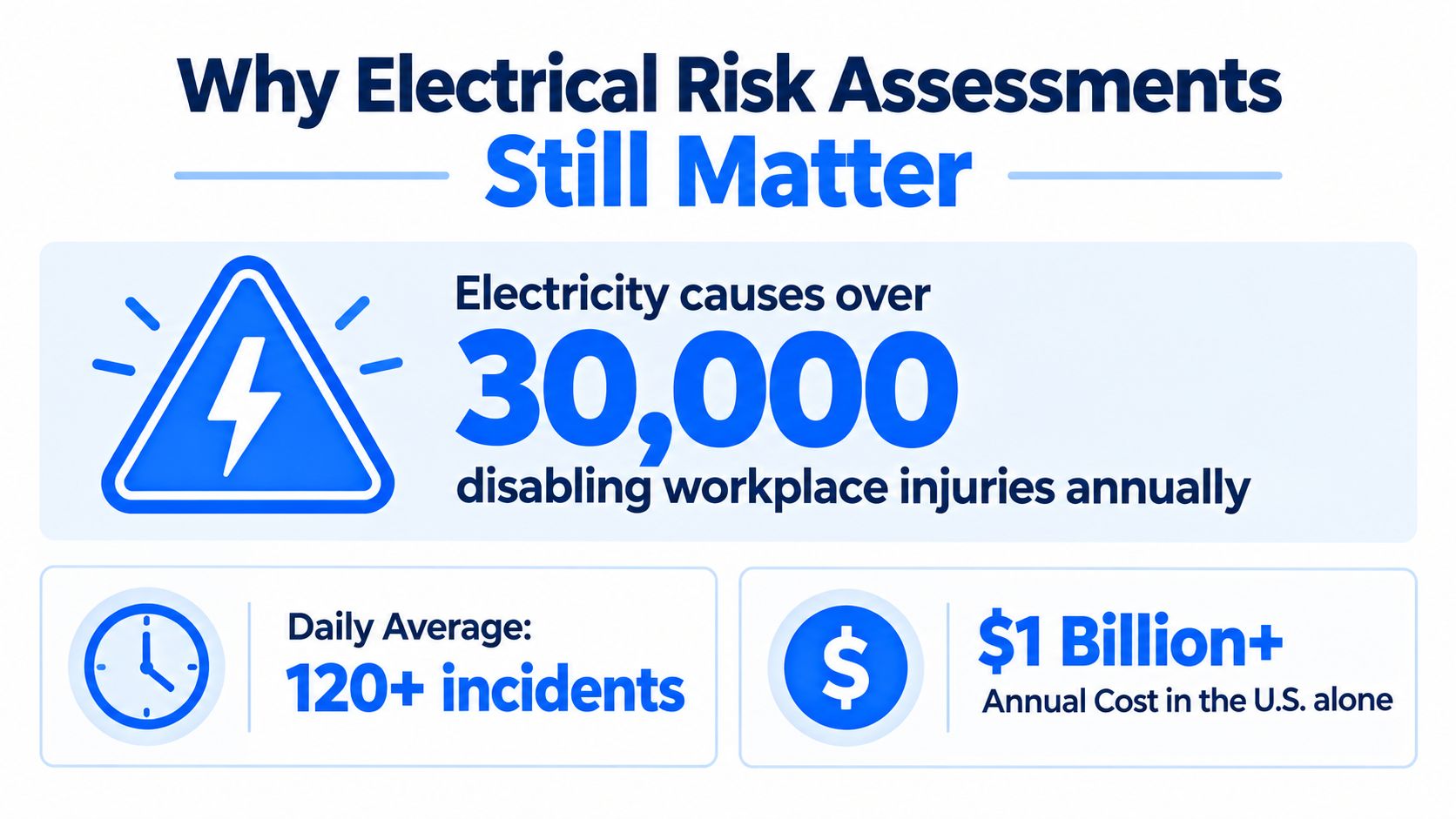
Electricity accounted for 3% of all workplace fatalities in 2020, down from 8% in 1980, yet exposure to electricity still caused 2,380 nonfatal U.S. workplace injuries in 2020. (Electrical Safety Foundation International workplace injury statistics) That decline reflects meaningful progress, not the disappearance of the hazard. Electrical systems have become more complex, and modern properties now combine traditional distribution equipment with EV chargers, battery storage, backup systems, and sensitive controls.
An electrical risk assessment turns that complexity into a documented plan. It identifies where shock, arc flash, fire, equipment failure, and outage-related problems can occur, then connects each finding to a practical control. For a homeowner, that may mean confirming a service can support a charger and battery system. For a facility manager, it may mean validating fault-current data, protective-device settings, labels, boundaries, and maintenance records before workers approach energized equipment.
Table of Contents
Why Electrical Risk Assessments Still Matter - The assessment is a control, not a form - Why construction and extraction deserve close attention
What an Electrical Risk Assessment Actually Includes - Start with condition and system information - Calculate the arc-flash hazard where it applies
Who Needs an Electrical Risk Assessment - The risk often sits outside the electrical department - Common triggers for scheduling one
Common Hazards Identified During Assessments - Immediate personnel exposure - Conditions that look like reliability issues
How Assessment Findings Drive Remediation and Upgrades - Separate urgent controls from planned improvements - Use calculations to test the upgrade path
Modern Loads Change What Assessments Must Evaluate - Capacity is only the first question - Include outage and environmental failure modes
Documentation Standards That Satisfy Inspectors and Insurers - Build an evidence trail - Treat the report as a living record
Why Electrical Risk Assessments Still Matter
Electrical exposure remains a workplace hazard because people encounter energized systems outside electrical installation work. A maintenance worker opening a disconnect, a roofer working near overhead lines, a contractor coordinating a service upgrade, and a facilities employee responding to a fault may all face risk without identifying as electrical specialists.
The decline in fatal incidents does not make the remaining exposure acceptable. The practical concern is who is still placed in the path of an electrical event, what task brings them near the equipment, and whether the site has controls that work under real conditions. Modern properties also add EV chargers, Powerwalls, battery storage, backup systems, and sensitive controls to traditional distribution equipment. Those loads can change fault paths, operating modes, isolation points, and the consequences of an outage.
The assessment is a control, not a form
A useful assessment answers practical questions before work begins:
What can hurt someone? The review considers shock, arc-flash energy, unexpected energization, overhead conductors, fire, equipment failure, and hazards created by batteries or other energy sources.
Who could be exposed? The group may include electricians, maintenance personnel, contractors, operators, cleaners, visitors, and anyone working near the equipment.
What prevents the event? Controls can include de-energizing, lockout and verification, guarding, equipment relocation, engineering changes, safe approach limits, training, and PPE.
What evidence supports the decision? A defensible report records the equipment examined, system information used, calculations performed, findings, photographs, and corrective actions.
A checkbox exercise records that someone looked at a panel. It does not show which conditions were found or how the risks will be controlled. A sound assessment connects the equipment, hazard, work activity, and selected protection in a traceable record.
Why construction and extraction deserve close attention
Construction and extraction work can place people near changing electrical conditions. Temporary power, mobile equipment, unfinished wiring, cranes, ladders, weather, and multiple contractors may alter the exposure from one shift to the next. A new charger, battery system, or temporary source can change those conditions again, even when the original service equipment appeared adequate.
For owners and managers, skipping the assessment can leave workers without clear boundaries, supervisors without a reliable work plan, and insurers or inspectors without evidence that hazards were considered. Complete the review before an installation, maintenance task, renovation, or new load changes the system. The goal is a documented decision about safe work, not a form completed after the hazard has already been introduced.
What an Electrical Risk Assessment Actually Includes
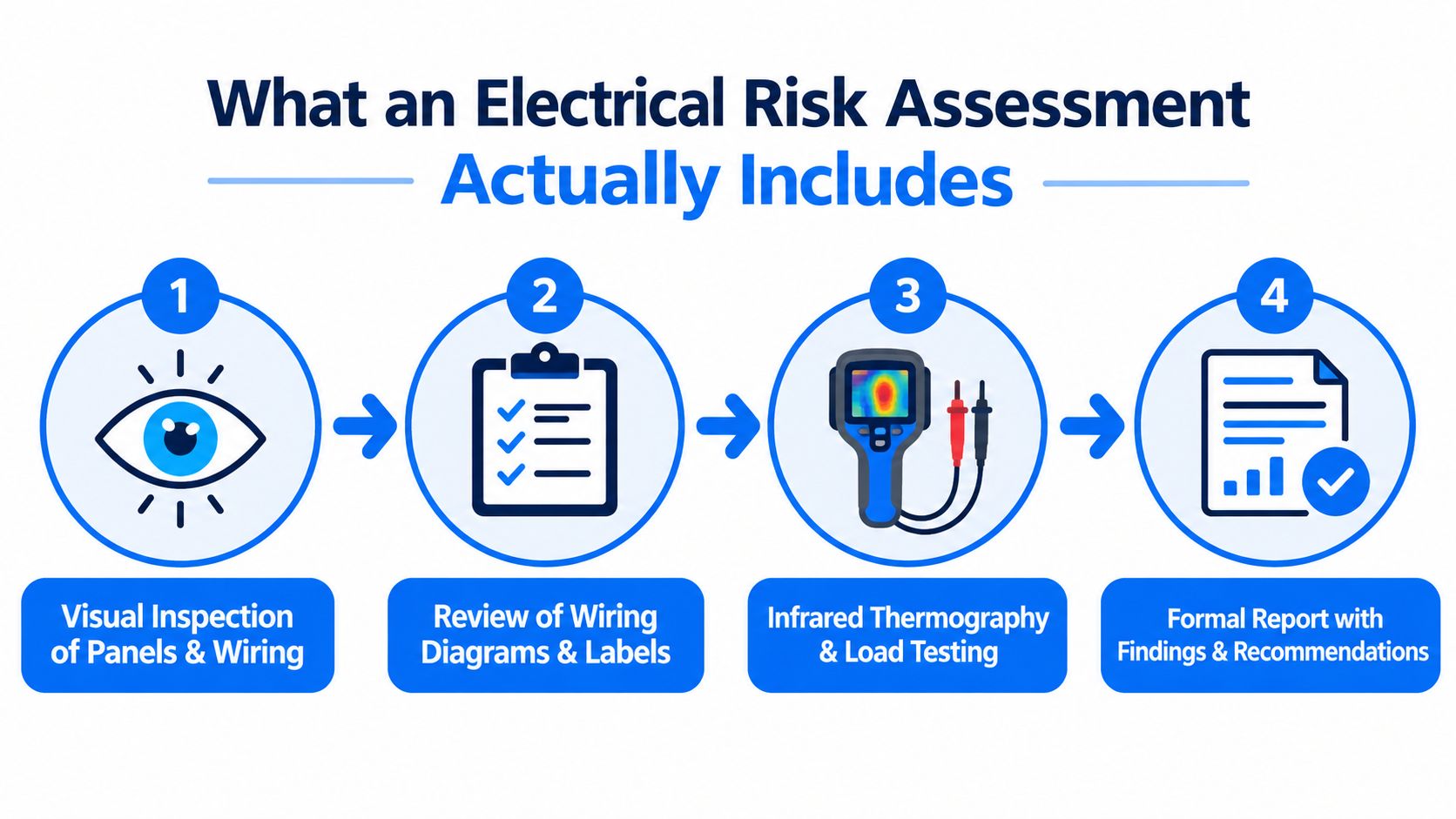
A proper review starts with the physical installation, not a template. The assessor walks the site, identifies the equipment in scope, checks available drawings and labels, and compares the records with what is installed. If the documentation says one thing and the panel contains another, the equipment in front of the assessor controls the evaluation.
Start with condition and system information
The visual inspection looks for damaged enclosures, missing covers, exposed conductors, corrosion, heat discoloration, poor terminations, blocked working space, incorrect labels, and signs of unauthorized modification. The assessor also reviews grounding and bonding, disconnect locations, conductor sizing, overcurrent protection, equipment ratings, and the condition of cable routes.
A basic walkthrough can identify obvious defects. It can't replace engineering analysis when the site has substantial distribution equipment, complex coordination, multiple sources, or workers who may need to access energized equipment. The right scope depends on the installation and the tasks people perform around it.
The assessor may also use infrared thermography, load measurements, and targeted testing where safe and appropriate. These methods can reveal abnormal heating, uneven loading, loose connections, or operating conditions that a visual check won't show. Testing must be planned carefully, because opening energized equipment creates its own exposure.
Calculate the arc-flash hazard where it applies
For three-phase AC systems, IEEE 1584-2018 is the core engineering method used for arc-flash risk assessments. Its validated application range is 208 V to 15 kV. Technical guidance warns that the model should not be used outside that range for defensible incident-energy calculations. (Arc-flash mitigation and power study specifications)
The calculation should produce two results at each significant location:
Incident energy, which describes the thermal energy a worker could encounter at a defined working distance.
Arc-flash boundary, which defines the distance at which the incident energy reaches the applicable threshold used by the assessment method.
Those results depend on real system inputs. Bolted fault current, protective-device clearing time, working distance, equipment configuration, and bus gap can all materially change the outcome. A report that copies values from an old study without verifying breaker settings, conductor lengths, equipment geometry, or available fault current may look complete while describing a different system.
Practical rule: If the equipment, protection settings, or system configuration has changed, treat the old assessment as unverified until the affected calculations and labels are reviewed.
The final report should identify assumptions, limitations, equipment locations, findings, recommended controls, and the person responsible for each corrective action. It should also distinguish a condition that requires immediate correction from an improvement that can be scheduled through normal maintenance planning.
Who Needs an Electrical Risk Assessment
Electrical risk assessments apply to people who manage exposure, not only to the electricians who perform hands-on work. A property manager adding workplace charging may need to understand service capacity, equipment placement, shutdown procedures, and the people who will operate or maintain the chargers. A homeowner adding a battery system needs an evaluation of the existing panel, service equipment, backup circuits, disconnects, and the interaction between utility and stored energy.
A general contractor coordinating a renovation faces a different set of questions. Which circuits will remain energized? Where will temporary power run? Can other trades work safely near the service entrance? Are overhead lines near lifts, scaffolding, or material handling areas? These questions belong in planning before crews arrive, not after an incident or failed inspection.

The risk often sits outside the electrical department
OSHA-linked workplace data compiled by ESFI found that 74% of workplace electrical fatalities from 2011 through 2023 occurred in non-electrical occupations. The same summary reports that 91% of those fatalities arose from a small group of common scenarios, led by overhead power line contact at 42.8% and unexpected contact with electricity at 19.3%. (ESFI workplace electrical fatality data)
That pattern changes how a responsible manager defines the assessment audience. The review should include anyone whose work, route, equipment, or supervision brings them near the hazard. A warehouse supervisor may need controls for mobile equipment near conductors. A facilities team may need procedures for opening switchgear. A cleaning contractor may need clear restrictions around electrical rooms.
Common triggers for scheduling one
An assessment deserves priority when:
A new load is added: EV chargers, heating equipment, production machinery, or storage systems can change loading and fault behavior.
The service or panel is modified: A replacement, upgrade, or feeder change can invalidate labels and previous assumptions.
The site has multiple energy sources: Utility power, generators, batteries, and photovoltaic equipment can create additional backfeed and isolation questions.
Workers troubleshoot or maintain equipment: The assessment should match the actual tasks, access points, and energized conditions.
The property has overhead line exposure: Work zones, vehicle paths, cranes, ladders, and temporary structures need deliberate controls.
A small residential project may need a focused site and load assessment rather than a full industrial arc-flash study. A commercial facility with complex distribution and routine maintenance may need a detailed engineering evaluation, updated labels, and a documented electrical safety program. The mistake is assuming the same report fits both.
Common Hazards Identified During Assessments
The obvious hazard is exposed energized metal. It deserves attention, but it isn't the only problem that puts people or property at risk. Assessors frequently find conditions where the equipment appears operational yet lacks the capacity, protection, labeling, maintenance, or physical arrangement needed for safe operation.
Immediate personnel exposure
Shock and electrocution risk can result from damaged insulation, missing barriers, incorrect grounding, deteriorated cords, open junctions, or a worker entering a space without understanding the approach limits. The danger may remain hidden until someone touches the wrong surface or a fault creates an unexpected energized condition.
Arc flash presents a different mechanism. A worker may not touch a conductor for an arc event to cause severe injury. Fault energy can produce intense heat, pressure, molten metal, and sound, especially where protective devices don't clear the fault promptly or where equipment geometry concentrates the event toward the working position.
Lockout and verification failures connect both hazards. A disconnect marked “off” isn't proof that conductors are safe. The worker needs an appropriate isolation procedure, identification of all energy sources, a test for absence of voltage, and controls against re-energization.
Conditions that look like reliability issues
Some findings first appear to be maintenance concerns but have direct safety consequences:
Overloaded feeders: Sustained loading can create heat, nuisance trips, insulation damage, and fire exposure. Added modern loads can make an old distribution path unsuitable even when the breaker hasn't tripped.
Poor terminations: Loose or deteriorated connections can produce localized heating and intermittent faults. A thermal image may support further investigation, but it doesn't replace a safe repair plan.
Inadequate working clearance: Crowded storage, relocated equipment, and blocked doors can delay isolation or force a worker into an unsafe position.
Incorrect labels and drawings: A mislabeled disconnect can waste time during an emergency and undermine every procedure based on the record.
Weak grounding and bonding: Fault current needs an effective path so protective devices can operate as intended. Missing or damaged bonding can leave metalwork at a dangerous potential.
A panel that still powers the building can still be unsuitable for the work people need to perform around it.
The useful comparison is not “safe versus unsafe” based on whether the lights work. It is normal operation versus controlled exposure during abnormal conditions. Risk assessments examine both, including what happens during a fault, outage, maintenance task, or future load addition.
How Assessment Findings Drive Remediation and Upgrades
A report has value only when someone can turn its findings into work. The strongest recommendations identify the hazard, explain the consequence, name the control, and assign a priority. “Upgrade electrical system” is too vague for a facility manager, contractor, or insurer to act on.
Separate urgent controls from planned improvements
Immediate controls may include restricting access, removing damaged equipment from service, correcting exposed parts, establishing a temporary barricade, or requiring de-energized work until a permanent repair is completed. These steps reduce exposure while the owner develops a design and procurement plan.
Permanent remediation depends on the cause:
A damaged enclosure may require repair or replacement.
A mislabeled panel needs field verification and durable identification.
An overloaded feeder may call for load redistribution, conductor changes, a new circuit, or a service upgrade.
An arc-flash concern may be addressed through protective-device settings, coordination changes, equipment modification, remote operation, or a revised work method.
A working-space problem may require moving stored materials, relocating equipment, or redesigning the room.
Cost is part of the decision, but it shouldn't be the only filter. A lower-cost change that leaves the underlying hazard intact isn't a real solution. Conversely, replacing an entire system may be unnecessary if verified calculations, protection adjustments, or targeted repairs reduce the risk adequately.
Use calculations to test the upgrade path
Arc-flash results can change when upstream clearing time, breaker settings, equipment geometry, or system configuration changes. That means remediation should be evaluated against updated calculations, not selected solely from a generic equipment list. The work may reduce incident energy, change the boundary, alter PPE requirements, or reveal that a different control is needed.
Panel replacement also deserves a full-scope review. A new enclosure doesn't automatically solve service capacity, feeder limitations, grounding defects, or coordination problems. Owners considering the project should also review this practical guide to electrical panel box replacement cost, then have the proposed work tied back to the assessment findings.
A useful capital request includes photographs, field observations, measured conditions, calculation assumptions, code or safety rationale, proposed scope, and consequences of deferral. That documentation helps stakeholders compare risk reduction with disruption and budget, instead of arguing over an undefined upgrade.
Modern Loads Change What Assessments Must Evaluate
An EV charger or battery system isn't just another circuit. It changes how the property uses power, how the service behaves during high demand, and what happens when the utility supply disappears. A charger may be idle most of the day and then become a sustained load. A battery can supply power when the grid is down, which means isolation and backfeed controls must be understood before anyone opens equipment.
Capacity is only the first question
For a home or small business, the assessment should examine the service rating, panel condition, feeder capacity, load-management strategy, voltage drop considerations, available fault information, and the physical location of the new equipment. It should also confirm that disconnects, labeling, clearances, and emergency access remain practical after installation.
Battery storage adds topology questions. Which circuits are backed up? Where does the transfer or isolation equipment sit? Can stored energy energize conductors that someone assumes are dead? Does the system support the intended critical loads, and can maintenance personnel identify every source before work begins?
A load calculation helps answer whether the installation can operate as designed, but electrical load assessment calculations shouldn't be treated as a substitute for a broader risk review. Capacity, protection, location, operating modes, and maintenance procedures need to agree.
Include outage and environmental failure modes
EV charging resilience introduces a concern that a traditional assessment may overlook: the charger can be electrically intact yet unavailable when people need it. Independent research found that severe weather and natural hazards are a primary cause of outages disrupting charging operations, while a related U.S. study found only a weak but statistically significant correlation between hazard risk and charger deployment. (Research on EV charging vulnerabilities and resilience)
That evidence supports a wider assessment scope. Review flood, wind, heat, fire, snow, vehicle impact, water exposure, and access constraints according to the site's actual conditions. Check whether outdoor equipment has appropriate protection, whether cables create trip or vehicle hazards, and whether a communications or control failure affects safe operation.
For storage-heavy properties, ask what remains powered during an outage, what shuts down, and who can safely reset the system. A modern assessment should describe normal, backup, fault, and recovery states. Otherwise, the owner may receive a code-compliant installation that still fails the practical test of safe, dependable operation.
Documentation Standards That Satisfy Inspectors and Insurers
A report should allow another qualified person to understand what was inspected, what was calculated, what assumptions were made, and what remains unresolved. Generic language creates doubt. Equipment-specific records create confidence.
Recent 2026 coverage across electrical-safety publications says authorities having jurisdiction are scrutinizing the credentials behind third-party reports, whether testing reflects the equipment installed, and whether the documentation is complete enough to reduce project risk. (Coverage of evolving electrical-safety documentation expectations)
Build an evidence trail
A defensible assessment package should identify:
The assessor: Include qualifications, scope of responsibility, date of fieldwork, and any limits on the evaluation.
The equipment: Record locations, identifiers, ratings, sources, protective devices, and relevant operating configurations.
The field evidence: Include photographs, drawings, labels, test results, observed defects, and notes about inaccessible areas.
The engineering basis: State the fault-current information, device clearing assumptions, working distances, equipment configuration, and calculation method used.
The action plan: Rank findings, specify interim controls, assign owners, and document completion or acceptance of remaining risk.
For arc-flash work, labels should match the equipment and the current study. For batteries and backup systems, the records should show the normal source, alternate source, isolation points, shutdown sequence, and any conditions that affect safe access. A report that omits those details may satisfy a filing requirement while leaving the field team exposed.
Treat the report as a living record
A one-time assessment becomes unreliable after a service upgrade, breaker change, battery installation, equipment relocation, or protection-setting adjustment. Maintenance history, inspection results, known defects, and completed corrective actions should feed the next review. Facilities with ongoing electrical exposure benefit from linking the report to work planning and periodic condition checks rather than storing it as an isolated PDF.
For a practical outline of the information a finished document should contain, review this guide to an electrical assessment report. The aim isn't paperwork for its own sake. It is a clear chain of evidence that helps inspectors, insurers, managers, and workers see the same system and make decisions from the same facts.
If you're planning an EV charger, Powerwall, battery backup system, generator, or electrical service upgrade, ask Amp'd Energy Solutions to assess the existing infrastructure before installation begins. Visit Amp'd Energy Solutions to discuss a site assessment and build a safer, properly documented electrical plan for your home or business.
Comments